Electrix Pro Warp Factory
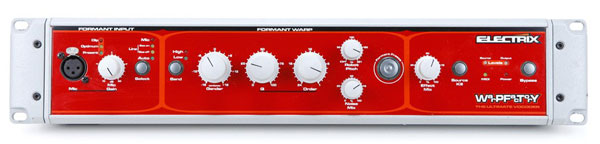
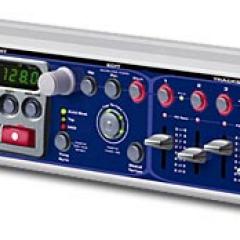
Designed for both DJs and Musicians, the Warp Factory is possibly the ultimate stand-alone Vocoder. With those great big knobs, the Warp Factory is designed for straight-forward hands-on use. It has an XLR Mic input (conveniently located on the front) and a quarter-inch line input for use as the Formant or carrier signals. Then there are two quarter-inch line-inputs and two RCA phono inputs for your stereo source sounds, either drum loops, mixes, songs, synth pads, etc...
The way it works is whatever Formant signal you have, say your voice, will be warped into taking on the characteristic of the Source signal you have, say a buzzy synth sound. This would in effect give you that Robot voice effect.
The Warp section is where you'll find most of the knobs and cool features of the Warp. There is a low- and high-pass filtering switch. A 'Gender' knob adjusts the pitch of the Formant. 'Q' adjusts the width of the filtering. An 'Order' adjusts the filter resolution for clear to abstract vocoding effects. There is also Noise and a built-in oscillator Source signal whose pitch is adjusted by 'Robot Pitch'. Various Bypass and Freeze switches and complete MIDI implementation make this the ultimate Vocoder for DJs, musicians and producers. It has been used by U2, John Digweed, United State of Electronica and the Chemical Brothers.
You Might Also Like


Demos & Media
Audio Clip 1
Hear a mix being tweaked through the Warp Factory for yourself!
Specifications
Inputs -
Formant: XLR Mic in, quarter-inch line in;
Source: 2 quarter-inch line in, 2 RCA phono in
Source: 2 quarter-inch line in, 2 RCA phono in
Outputs -
Quarter-inch line out
LFO -
None
Filter -
High- and Low-pass
Effects -
Robot Pitch (built-in oscillator), Noise Mix (built-in noise gen)
Keyboard -
None
Memory -
None (you can save your settings to MIDI)
Control -
MIDI
Date Produced -
1999
Resources
Images from Perfect Circuit Audio.