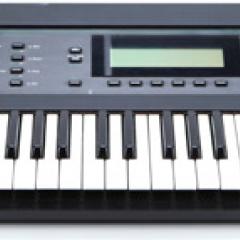
Alesis QS8
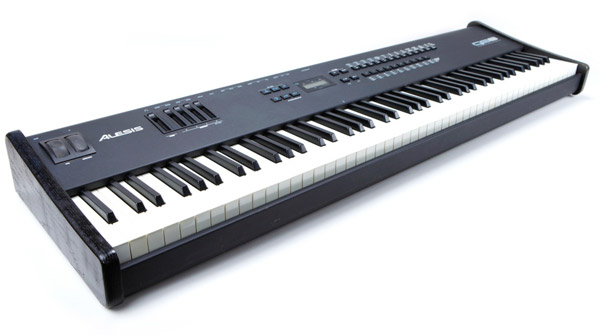
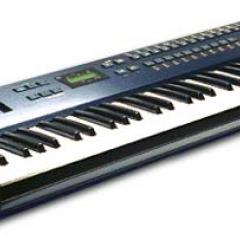
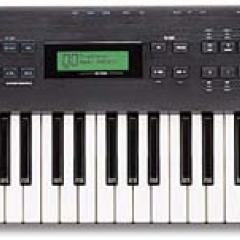
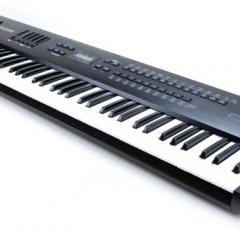
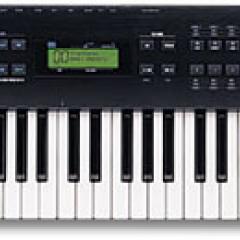
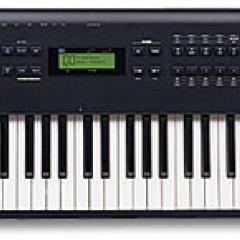
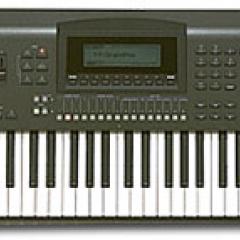
The QS8 came out on the heels of the QS7 and was an even more professional quality version - it was Alesis' flagship model! It featured a full 88-note weighted keyboard with piano style hammer-action and a strong all-metal chassis with black solid oak end-pieces. Otherwise, it's identical to the QS7, with 16 MegaBytes of sample/synthesis ROM (expandable to 32 MegaBytes), 4 stereo outputs, 4 control sliders, discrete MIDI OUT and THRU ports, a third Expression Pedal input, ADAT optical digital output, 48kHz clock input, and a second PCMCIA expansion card slot.
The QS8 is undoubtedly a powerful and flexible synthesizer capable of creating rich sounds - both acoustic and electronic. There's 64 voices of polyphony and 16 parts multitimbrality and tons of memory and expand-ability! The QS8 uses digital additive/subtractive sample playback synthesis to create high quality stereo grand pianos, organs, strings, drums/percussion, brass, woodwinds, new and classic synth textures, General MIDI, and rhythmic/sonic loops. Most of them sound pretty darn great too! Keith Emerson wrote the demo for it, as well as some patches.
As a master synth, the QS excels in it's price range, except for that tiny LCD display which makes navigating through the pages and pages of program settings pretty tedious. The QS8 implements the powerful QS Modulation Matrix, allowing users to assign virtually any controller source to any modulation parameter. There's an onboard multi-effects processor (based on the QuadraVerb 2) with four totally discrete effects busses that include reverb, delay, rotary speaker simulation, distortion, chorus and much more. With a direct Mac or PC hook-up, loading patches and editing via software is a snap! QS synths shipped with Alesis' Sound Bridge software for Mac/PC which lets you write AIFF and WAV samples, Standard MIDI Files and Program data to PCMCIA Flash or SRAM cards. It can play Standard MIDI file sequences from the expansion cards without the use of an external sequencer. For a top-quality synthesizer that isn't focused just on dance or trance, be sure to consider the QS8.
The QS7 is a mid-sized 76-note keyboard version with semi-weighted keys for players who need that realistic feel at a more affordable price. The QSR is identical to the QS7 and QS8, except that it is a keyboard-less rackmount version. 1999 saw the release of the updated QS8.1 which was a vast improvement over this original.
You Might Also Like

Demos & Media
Audio Clip 1
Here are a bunch of demo patches from the QS7, displaying the QS-synth's wide range of excellent contemporary, acoustic, and electronic synth sounds & textures. From the Future Music CD, issue 51.
Specifications
Polyphony -
64 voices
Oscillators -
48kHz Linear samples.
16MB, expandable to 32MB using 2 PCMCIA ROM and RAM cards
16MB, expandable to 32MB using 2 PCMCIA ROM and RAM cards
Multitimbral -
16 parts
Effects -
4 On-board effects, based on the Alesis QuadraVerb 2 FX processor
Arpeg/Seq -
None
Keyboard -
88 velocity and aftertouch sensitive, weighted, hammer-action
Memory -
512 preset 128 user programs, 400 preset and 100 user mixes, expandable using PCMCIA cards
Control -
MIDI IN/OUT/THRU (16-parts), RS232/RS422 computer serial port for Macintosh or PC
Date Produced -
1996
Websites of Interest
Resources
Images from Perfect Circuit Audio.