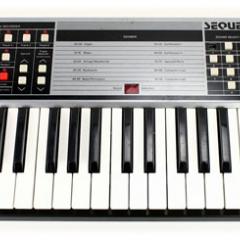
Sequential Circuits MultiTrak

Sequential MultiTrak Image

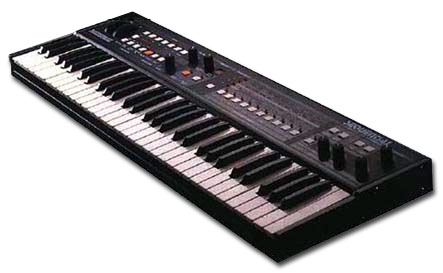
Sequential's MultiTrak had everything - for its time - and to this day, it still sounds great! During the era of the Roland Juno synths, Sequential overhauled their programmable little SixTrak analog sequencer synthesizer and came up with the MultiTrak. It's a six voice analog synth with sophisticated filters, envelopes, modulation capabilities and built-in sequencing.

As was the developing trend around this time in the mid-eighties, programming was being streamlined into using the buttons on the matrix keypad to assign parameters to a rotary knob. (The only dedicated knobs are for sequencer volume and speed, chorus depth and rate, master tune and volume.) There are 99 memory patches for your analog sound creations. It also features a nice arpeggiator with hold and transpose functions. But lying at its heart is a sophisticated (for 1985) onboard sequencer. It could store up to four polyphonic sequences with a metronome, 1600 note memory, an overdubbing mode and quantizing (autocorrect) functions, individual track volume and speed controls. Sequences could be chained together and patches could be changed on the fly. Sequences are recorded in real-time (no step-time modes here).

Additional features include MIDI in/out, six separate audio ouptuts (one for each voice) and a stereo output, built-in stereo chorus effect and a 5-octave keyboard with velocity sensitivity and split/layer modes (layer up to six different patch sounds onto one note). With an original list price of about $1,500, these days they can be found closer to $300 - a great bargain for classic Sequential sounds with onboard sequencing and patch memory.

16 Visitor comments
BobthePlanet
September 15, 2009 @ 9:23 pm
I have owned a Multitrak since 1985 and it has always been one of my favorites - alongside my SCI Pro One. One of the features that is rarely mentioned is the ability to do additive synthesis in addition to the more common subtractive. This is easily accomplished with its "Stack" feature, which is not simply a detuned "Unison" mode as is usually found on these older synths. Any or all of the six voices in the stack can be the same or different patches. Conceivably, you could create 6 wave patches representing the harmonics of a particular timbre and add them together. However, this leaves you in monophonic land as you truly only have 6 voices to play with. [cont.]
BobthePlanet
September 15, 2009 @ 9:22 pm
But you can create complex waveforms with 2 or 3 voices where each has its own envelope for the VCO, VCF, and VCA along with all the other parameters available. This will allow chord or duotone fingering. Stacking percussive bells can give excellent approximations of vibraphones or glockenspiels. Stacking different horn sounds gives a powerful brass ensemble. If only there were more voices available this would have had an unbeatable analog sound. The only other shortcoming I feel it has is the "softness" of the sound. Sometimes it seems like the MultiTrak is too mellow - but that's analog for you.
BobthePlanet
September 15, 2009 @ 9:21 pm
I have owned a Multitrak since 1985 and it has always been one of my favorites - alongside my SCI Pro One. One of the features that is rarely mentioned is the ability to do additive synthesis in addition to the more common subtractive. This is easily accomplished with its "Stack" feature, which is not simply a detuned "Unison" mode as is usually found on these older synths. Any or all of the six voices in the stack can be the same or different patches. Conceivably, you could create 6 wave patches representing the harmonics of a particular timbre and add them together. However, this leaves you in monophonic land as you truly only have 6 voices to play with. [cont.]
slide
February 28, 2009 @ 6:18 am
I need the informantion on how to download from the factory cassette to load the Squential synthesizer model 615 sound back on the memory.The problem that I'm having is the battery is not keeping it
memory.So I;m going to replace the backup battery because it has
go dead.
lefreak
November 4, 2008 @ 6:12 pm
Might sound silly but i had one years ago and from memory the main output socket is a stereo 1/4" socket.... not 2 mono sockets as per norm, this has fooled a few people when getting it to sound correct.....
 
Post Comment!
VSE Rating

Awesome!

User Rating

Rated 3.91 (157 Votes)

  • Specifications
  • Polyphony - 6 voices
  • Oscillators - One VCO per voice. Saw / tri / pwm / noise with Tuning and glide
  • LFO - One LFO with square / triangle / depth / rate
  • Filter - cutoff, resonance and key follow + ADSR.
  • VCA - Three ADSRs per voice
  • Memory - 99 patches
  • Effects - Stereo chorus
  • Keyboard - 61 note, velocity sensitive with split/stack settings
  • Arpeg/Seq - Arpeggiator (up/down) / 1600 note sequencer with quantize and overdub.
  • Control - MIDI IN/OUT, Sync pulse IN/OUT
  • Date Produced - 1985
  • Resources & Credits
  • Images from Synthony.

    Review updated October 2010

Errors or Corrections? Send them here.