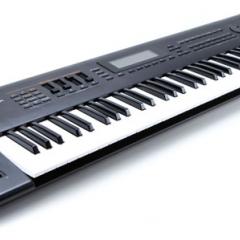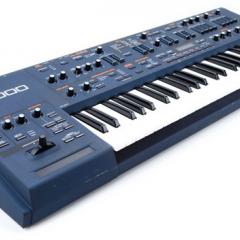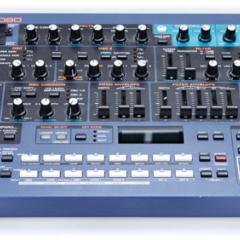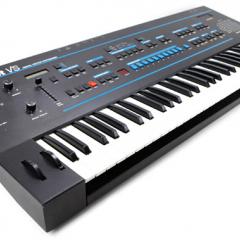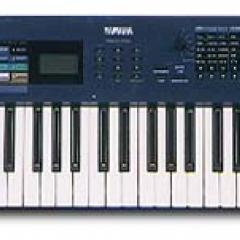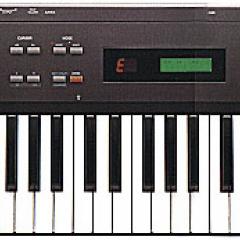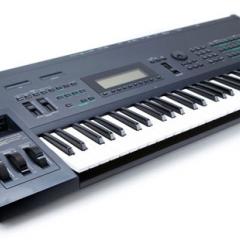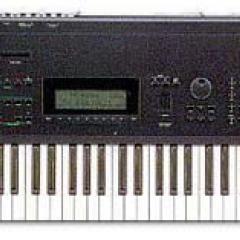
Yamaha SY22

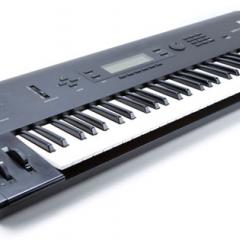
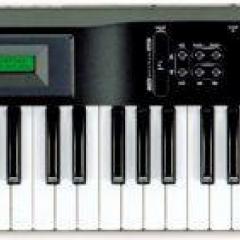
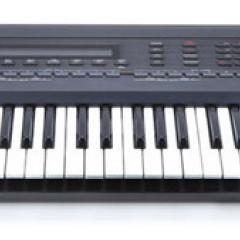
Yamaha SY22 Image

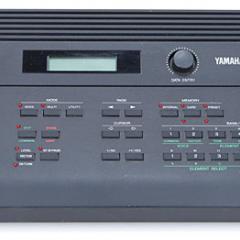
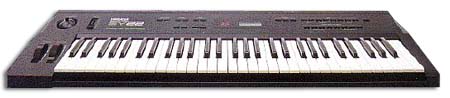
The SY22 is one of these digital synthesizers with a thin metallic sound. It uses a synthesis method known as vector synthesis (similar to that on the ProphetVS and Korg Wavestation) in which samples and FM sounds (adapted from Yamaha's DX line) are altered and combined using the on-board joystick to create new and often interesting sounds. Joystick moves can be recorded and repeated too, a feature rarely seen until the JP-8000 came!

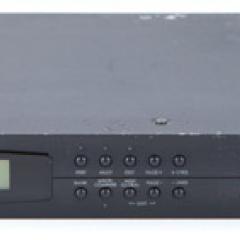
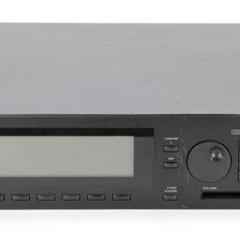
There is no filter, no resonance, no ring modulator sand no sign of any arpeggiators or sequencers on-board. Although this is unfortunate, its strengths lie in its ability to record data manipulation in real-time and its multitimbrality - both of which lend themselves to creating some complex and cool sounds perfect for ambient, dub and industrial styles. It also has a drum kit sound set and simple built-in effects. A desktop module version of the SY22 is the TG33 which also has increased memory. The SY22 has been used by Moby, Skinny Puppy and Scanner.

36 Visitor comments
Alessio
February 11, 2010 @ 3:49 pm
In addition to all the positive things already stated here (which I fully agree with), there are also two major letdowns:

The FM implementation is only 2-OP FM (not 4-OP). Although you can combine two 2-OP FM sounds, that doesn't really make 4-OP, since you cannot modulate one with another. The sound variety you can get out of 2-OP FM is not very impressive.

The other problem is that most sounds that make you go "wow" are nothing else than a ROM wave sample. What sounds like the result of an incredibly great synth engine (think complex evolving pads) is really just a sample that was probably created with another synth - that's a bit of cheating in my book. Since there aren't that many samples to start with, and samples cannot be tweaked at all, you can actually only create a fairly limited amount of different sounds.
Peter Kadar
February 8, 2010 @ 1:13 am
This was one of the first pro synths I ever had.

FM info is correct in stating that there are no filters in this version of FM. What was happening was an FM level amount that does have a similar end result to filtering. I agree that the sound was somewhat thing, but the FM side of things brought in some warmth, and, paired with the AWM waves, and throwing in some vector motion, a decent sound can certainly be made.

You can approximate filtering by assigning brighter waveforms and then using the joystick to crossfade between them. It's a compromise of course, but still quite musical.

This was intended as a beginner synth for those who couldn't afford an M1, D-50, or SY-77 at the time. For the price point, it was a good starter synth. Be sure to check out it's patch generating 'random' function for some extra fun!
Edelce
October 27, 2009 @ 6:39 pm
Sun Ra ocupó uno de estos al cosa de su vida.
Smithy
October 16, 2009 @ 5:57 pm
I used one for 3 years, mainly to put notes in to my Atari ( / cubase )
that how old this synth is !
The sounds are interesting if a little thin, the random mode select 4 voices and every now and them a real sonic gem comes out.

The keyboard is very good, better than similar priced Rolands like the D5/10/20 or Kawai K1 etc.
I sold mine to buy an SY77 - which is a beast !!!
FM info
June 23, 2009 @ 11:20 am
@sir raven: FM synthesis does not use 'subtractive synthesis' type filters.
 
Post Comment!
VSE Rating

Excellent

User Rating

Rated 3.48 (357 Votes)

  • Demos & Media
  • YouTube Thumbnail
    Video 1
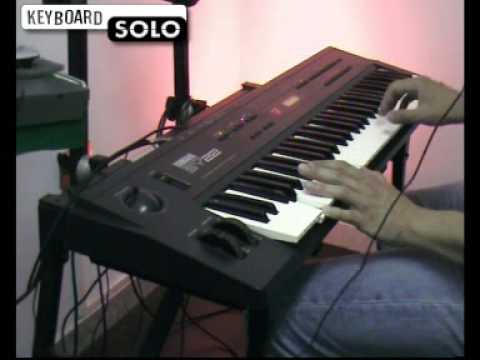
    - Yamaha Sy22 Vector Synth (Wavestation Korg - D50 Roland) demostration by S4K

    Manual - Download the original owner's manual here.

  • Specifications
  • Polyphony - 16 notes (8-part multitimbral)
  • Oscillators - 2 digital FM Operators and ROM samples (2 osc per voice)
  • LFO - Amplitude Mod & Pitch Mod with Saw Up, Saw Down, Triangle, Square and Sample&Hold waveshapes
  • Filter - None
  • Effects - 16 Digital Reverbs and Delays
  • Keyboard - 61 keys (with velocity and aftertouch)
  • Memory - 64 preset / 64 user
  • Control - MIDI IN/OUT/THRU (8 channels)
  • Date Produced - 1990

Errors or Corrections? Send them here.