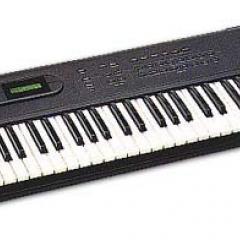

Yamaha TG500

Yamaha TG500 Image

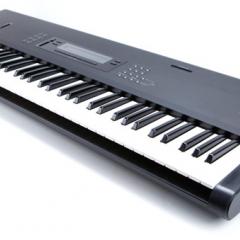
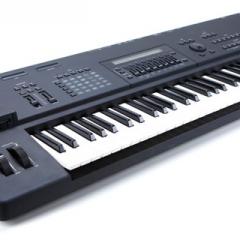
The TG500 is basically a box-o-sounds. It is based on Yamaha's SY85 (1992) and doubles the polyphony but loses the sequencer and most of the buttons and controls for real-time and patch editing. You can go with just the stock sounds, their sound quality is excellent, using AWM2 (Advanced Wave Memory), Yamaha's synth-engine of choice since the days of FM-synthesis. You can also add external ROM cards for many more sounds in various styles. Despite the lack of controls, the TG500 has edit capabilities as extensive as the SY-85, and is easiest to program using an external or software based editor.

But as we said, it's a box-o-sounds with four expansion card slots right on the front-panel (two slots for data cards & two slots for wave cards) and a big fat volume knob. Six individual audio outputs make tracking or live PA mixing possible. It has three basic modes of operation: Voice - allows access to one patch at a time. Multi - allows up to 16-part multitimbral patches for sequencing. Performance - split/layer up to 4 patches across keyboard. Like the SY-85 it's got multi-mode filters and a dual-effects processor with chorus, flange, reverb, delay, exciter, parametric EQ, echo, ring modulation, leslie, distortion, etc. The effects can be used in series or parallel, and there are 4 busses to route sounds through them. The TG500 was a great and economical way to get Yamaha's AWM2 style sounds, but may seem limited today.

15 Visitor comments
boyd sibley
November 27, 2011 @ 2:15 pm
Hey Benny Harris, you mentioned you wanted a TG500, I saw one on Ebay today
under Yamaha TG500 synth module. Hope you find one
benny harris
October 21, 2011 @ 11:03 am
I've owned many synths over my 30 years of music predutcion and performing. I made the serious mistake of selling my tg500 buying 'new' technology. I'm sorry I did that. The tg500 is an exceptional module that has a sonic character that I miss very very much. I'm looking for one right now. I own a Kurzweil k2500s which also is irreplaceable and use Reason 5 and although that set up great I miss the tg500
oxygene65
February 13, 2011 @ 12:33 am
I've owned a TG500 from when they first came out, it was my main piece of equipment for a long long time. Because of that I spent all my time using it and programming some great sounds. I found editing sounds pretty easy and managed to get some fantastic sounds out of it. Since then I went on to buy a JV1080 and an XV5080 to add to my racks. I have to say that the Yamaha has a quality, a warmth and character, that the Rolands do not. In fact neither the 1080 or 5080 has inspired me as much as the TG500. Its a fantastic bit of kit that still sounds great today. I love it to bits.
bret
September 19, 2010 @ 5:11 pm
Really REALLY Excellent 'classic' Rompler. Had one of these since they came out and it's never failed me. Sure newer waves have come out in all the latest racks but these have character, and as they are so cheap and have quality effects there's really no reason not to add one to your setup. TG-500 will always stay as it can do a lot of things.
Alex
May 25, 2010 @ 1:09 am
I just add this beautiful module to my palette of sound on my rack, very nice sound quality, vast memory, easy to use, fair good effects, and the original sound programs are very useful for ambiance music, the brass sound are really good, main piano has a nice brite sound with deep low end, the Electric pianos sound like real DX series with nice effects, AWM2 was great.
 
Post Comment!
VSE Rating

It’s Good

User Rating

Rated 4.09 (239 Votes)

  • Demos & Media
  • YouTube Thumbnail
    Video 1
    - Yamaha TG500 Demo Sound Synth Parte I by Morpheus2027
    YouTube Thumbnail
    Video 2
    - Yamaha TG500 - New Demo Sound Synth By Morpheus2027
    YouTube Thumbnail
    Video 3
    - Yamaha TG500 Demo Sound Synth Parte II by Morpheus2027

    Manual - Download the original owner's manual from SoundProgramming.net.

  • Specifications
  • Polyphony - 64 voices voices (2 x 32)
  • Oscillators - AWM2 (2nd-generation Advanced Wave Memory)
  • Filter - Digital LPF, HPF, BPF, BEF (Band Elimination Filter)
  • Sequencer - None
  • Effects - 2 Discrete FX units, each with 90 effect types (Chorus, flange, reverb, delay, exciter, EQ, ring modulation, leslie, distortion, etc.)
  • Keyboard - None
  • Memory - 384 Patches, 252 Performances
  • Control - MIDI (16-part multitimbral)
  • Date Produced - 1992

Errors or Corrections? Send them here.