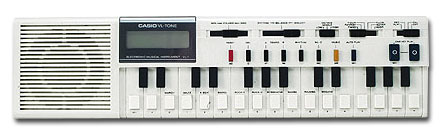
Casio VL-Tone VL-1

Casio VL-1 Image

This seemingly worthless synth/calculator hybrid weighing in at under a pound has somehow found fame and fortune despite looking like a kid's toy. Its ultra cheesy sounds have been discovered and immortalized in the hit songs of such artists as Trio for "Da Da Da" and White Town. The Casio VL-1 or VL-Tone as it's also called has 29 little calculator-type button keys, five preset and one user memory patches, built-in rhythm machine (waltz, swing, rock, samba, etc.) and a 100-note sequencer. There is no chance at any external or MIDI control and there are no filters or effects. There is an LFO with vibrato and tremolo effects and an ADSR envelope.

The tinny monophonic blips and beeps that come out of the VL-1 provide a childishly funny accent to your music, if you're into that sort of thing. The VL-1 is analog, it's tiny, it has a built-in speaker and a useless built-in calculator. The synth itself is quite small, light-weight and portable when running on batteries. The keys are unreliable and cheap soft buttons with absolutely no natural feel, response, aftertouch or velocity. The VL-1 was succeeded by the VL-10 (same spec, smaller case) and VL-5 (4-note polyphonic version with a useless bar-code reader). Strangely, the simple cheesy sounds of the VL-Tone have been used by Apollo 440, Devo, the Talking Heads, the Cars, Dee-Lite, Sting, Stevie Wonder, Vince Clarke, Beastie Boys, The Human League, Trio, White Town, and Bill Nelson.

54 Visitor comments
bresk
February 12, 2009 @ 10:43 am
...and if you have a kaoss pad the fun reach another level ;)
Nafs Kushi
February 4, 2009 @ 5:23 am
It's been the first "keyboard" I ever played when I was 7, and I think that's why I love electronic music. I'd recognize its sound everywhere, it's so typical you can't go wrong!
The one I played when I was a child was my sister's one. I bought one ALL MINE a few days ago, and I'm gonna use it in studio and on stage. I LOVE IT!
planetplayer
January 15, 2009 @ 8:26 pm
Unfortunetly, I did not have time to multisample this. I think this had a line out jack becuase I wished I had sampled from speaker and line out jack. So it must have been line out. I wish I had a V-Synth GT to time strech this stuff. The VL-1 is fun to play. I played monophnically a Mozart Piano sonata in C on this. Little kids physically abused this, but it stil maybe working. Programming this is the opposite of D-50 or Wavetstaion for sure. Just 9 parameters for Synth mode. Percussion is beatiful. I think my father paid $101 and some cents tax included for this. I seen the receipt. It came with a nice leather look light tan vinyl case with brown piping and casio printed on it. It had a calculator was primitve but nice. I love this even with the chicklet keys. One day I wish to sample all of it for better results. OB-1 would be better to put money on. It's not junk it's just something that stirs inspiration like that hit song.
planetplayer
January 15, 2009 @ 8:20 pm
My father gave it to my sister as a present in the 90's. I borrowed it off my sister and sampled for my use, all impressive drum patterns like the famous beguine, latin and bossa nova beats, the preset tones and a few tones with that funky maybe not funky LFO panning type sound. The LFO is electronic sounding but not like a synth or home keyboard, its just unique. I think the wave shape is triangle and some square SOUNDING depending on tone.
planetplayer
January 15, 2009 @ 8:19 pm
One of my favourites. I wuld like to make a hit record with this one seriously. I heard one of it's famous drum beats in a movie by that top artist mentioned. My father had this baord since it came out. I was never allowed to use it except once. This is where I practiced basic attack decay sustain release before owning a full programmable. ADSR is an instrument preset as well as piano,guitar etc.. but this mode is tricky. Once ADSR preset is selected, the LCD looks like calculator mode and you have to type 8 or 9 integer numbers. Each number held a weight/value. The first number is like a basic tone like paino, guitar etc, the other numbers are basic tone control/pan LFO I think, which may not work on all basic sound tones and 5 number values are for attack decay sustain and release and volume. Once programming is done you hit calculator M+ key and your patch is memorized.
 
Post Comment!
VSE Rating

Don’t bother

User Rating

Rated 4.11 (771 Votes)

  • Specifications
  • Polyphony - Monophonic
  • Oscillators - 1 VCO
  • LFO - Vibrato, Tremolo
  • Arpeg/Seq - Sequencer: 100 notes, 1 pattern. Rhythm Machine: March, Waltz, Swing, Rock, Samba, Beguine, Bossa Nova
  • Effects - None
  • Keyboard - 29 tiny keys (with 3-position octave switch)
  • Memory - 1 user patch, 5 preset sounds, 10 built-in rhythm patterns
  • Control - None
  • Date Produced - 1979 - 1984

Errors or Corrections? Send them here.