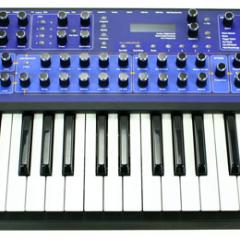
Dave Smith Instruments Evolver
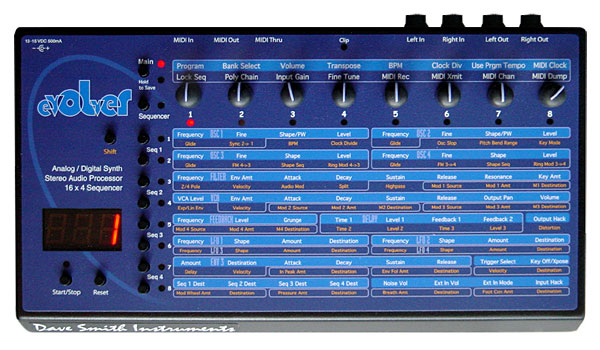
Released in 2002, Evolver is the first instrument to come from Dave Smith Instruments. Dave Smith is considered a legendary figure in the synthesizer world, he founded Sequential Circuits and designed such classics as the Prophet 5 and Prophet VS, and he was a pioneer in bringing MIDI to synthesizers. After a stint working in Software Synthesis for Seer Systems, Dave collaborated with Roger Linn on the Adrenalinn, and then officially came back to the world of hardware synthesizers. And the world was happy to find him back designing synths for a new generation of players - starting with Evolver!
So, there's no keyboard on this thing! Well, it's a hands-on desktop sound module and audio processor. The Evolver is a true analog synthesizer that incorporates many of Dave and Sequential's old secrets, circuits and technologies. It's monophonic with four oscillators - two analog DCOs and two digital - it's a true analog/digital hybrid synth. The analog oscillators feature multiple classic waveforms plus pulse-width modulation and hard sync, and they sound really nice and big. The digital oscillators feature FM synthesis, Ring Modulation and 96 wavetables straight out of the Prophet VS (plus 32 user wavetables, loaded via MIDI software editors such as Motu Unisyn).
Evolver also features two Curtis voltage-controlled analog low-pass filters which are fully resonant and switchable for two- or four-pole operation, two digital highpass filters and real analog VCAs. Modulation capabilities are handled by four LFOs and three ADSR envelope generators (for the filter, the amp, and one is user assignable). There are dedicated onboard effects (feedback, delay, distortion, glide, etc.). Stereo audio inputs let you process external audio through the Evolver's filters, envelopes, LFOs and effects.
One of its coolest features is the MIDI-syncable 16-step, 4-parameter, analog-style sequencer (with each patch able to store its own sequence) which really brings the Evolver to life with animated evolving sounds. The LFOs, step sequencer, and three separate delays can all be synced for massive, rhythmic, time-based effects in stereo. As for programming and tweaking all these functions, Evolver's easy-to-navigate matrix-style interface allows for quick editing and real-time control of 8 parameters simultaneously.
A major unique feature of the Evolver is that although it is monophonic, it has a true stereo signal path. The reason many things come in multiples of two here is because each channel gets its own independent analog oscillator, lowpass filter, highpass filter, VCA and effects. It's sort of like two independent synths - one on the left and another on the right. This allows for pretty nice stereo imaging effects not possible with most other mono-monophonic synths. Some of the factory patches will make your jaw drop - sometimes it's really hard to believe it has only a single voice!
It's no surprise the Evolver was a hit when it came out. There just are no other modern analog-digital synthesizers in its price range, it sounds wonderful, and is one of those synths that has no real need for external effects or sweetening. Evolver literally is a rebirth of the best of Sequential Circuits, updated to meet the needs of today's musicians. The internal computer and DSP chips can be reprogrammed via MIDI, for easy bug fixes, OS updates and feature additions. Other forms of the Evolver that have evolved: Mono Evolver (a keyboard version), Poly Evolver (a polyphonic keyboard version), and Poly Evolver Rack (a polyphonic rack module).
You Might Also Like
Demos & Media
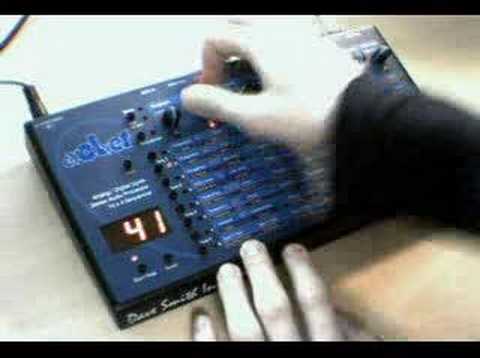
Ghostradioshow #07[Desktop soundscape]
ManualDownload the original owner's manual from SoundProgramming.net.
Specifications
Polyphony -
Monophonic
Oscillators -
2 digitally controlled analog oscillators (DCOs) with selectable sawtooth, triangle, saw/triangle mix, and pulse waves (with pulse-width modulation), and hard sync;
2 digital wavetable oscillators with Prophet VS waves and wave sequencing capability, FM and ring modulation.
White noise generator.
2 digital wavetable oscillators with Prophet VS waves and wave sequencing capability, FM and ring modulation.
White noise generator.
LFO -
4 LFOs each with sawtooth, triangle, ramp, pulse, and random waves. Each LFO can be routed to any destination in the matrix. Can sync to MIDI clock.
Filter -
2 Low-pass filters: 1 analog Curtis filter per channel, selectable 2- and 4-pole operation (self-resonating in 4-pole mode) and ADSR envelope generator.
2 digital 4-pole Highpass filters.
2 digital 4-pole Highpass filters.
VCA -
1 analog VCA per channel with ADSR envelope generator
Arpeg/Seq -
16 x 4 analog-style step sequencer that syncs to MIDI clock.
Keyboard -
None
Effects -
Digital delays: 3 separate, syncable, stereo delay lines.
Dual (left and right channel) tunable feedback loops with "Grunge": use feedback as a pitched sound source.
Distortion! Digital, one for each channel, can be placed before or after analog electronics; and "Output Hack."
Separate Glide per oscillator.
Dual (left and right channel) tunable feedback loops with "Grunge": use feedback as a pitched sound source.
Distortion! Digital, one for each channel, can be placed before or after analog electronics; and "Output Hack."
Separate Glide per oscillator.
Memory -
512 fully editable programs (four banks of 128).
Control -
MIDI In, Out, and Thru
Date Produced -
2002 - present
Websites of Interest
Resources
Images from Dave Smith Instruments
Additional info provided by Miles Bader and David Bryce.
Reviewed December 2007