E-mu Audity
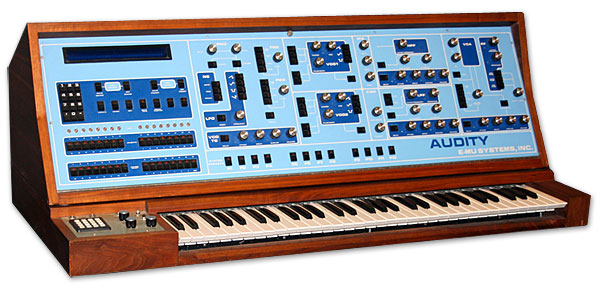
Only one Audity ever came off the assembly line. At the time, it was a state of the art computer based analog synthesizer commissioned by ex-Tangerine Dreamer Peter Baumann in 1979. It came at a time when E-mu, like other synth manufacturers of the time, were making a move towards producing an instrument that was more compact and more advanced than the purely analog modular beasts they had been making. Under pressure from synths like Sequential's Prophet-5, E-mu set out to make a very powerful analog synth. The Audity was a 16-voice instrument with a massive amount of programmability and stability thanks to the computer based technology that controlled it.
Unfortunately the instrument was so expensive ($70,000) that nobody wanted to buy one. It was also a bear to program. E-mu wound up shelving it in order to start over with a new concept inspired by the Fairlight. This led to a sophisticated and much cheaper sampler - the Emulator 1. But the Audity had not been forgotten by E-mu. Much of the Audity's multi-timbral design went into the creation of the sample-playback Proteus synthesizers, which in turn paved way for the Audity 2000 sound module!
The one and only living Audity is currently in a synthesizer gallery at the CANTOS Music Foundation in Calgary, Alberta Canada. It was never actually completed, so it has never actually worked. As such, it remains a truly one-of-a-kind show-piece of what could have been - the synthesizer equivalent of a concept-car.
You Might Also Like
Specifications
Polyphony -
16 voices
Oscillators -
2 SSM Chips with multi-waveforms, Noise Source per voice
LFO -
Yes
Filter -
SSM Filter Chips: High-Pass Filter, Low-Pass Filter. Separate resonant Filter also available.
Envelopes -
Envelopes gens for VCOss, VCFss, and VCA's
Memory -
Multi Patch Storage
Keyboard -
61 keys
Date Produced -
1979/80
Websites of Interest
Resources
Images from Flickr.