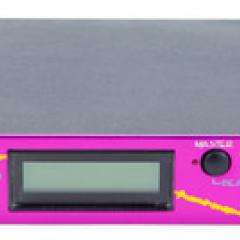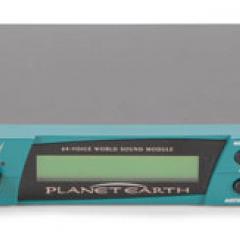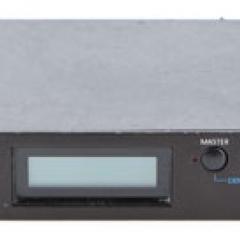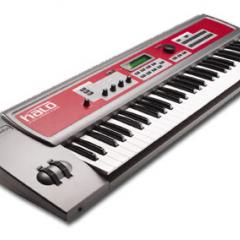
E-mu Morpheus

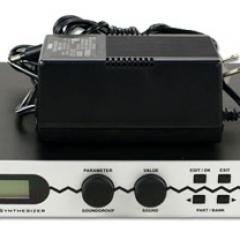
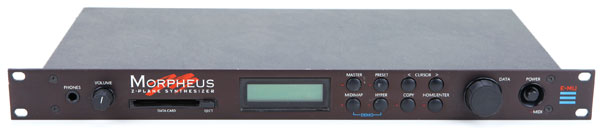
E-mu Morpheus Image

The Morpheus has its claim to fame with the ability to "morph" sounds creating unique, evolving and intricate sounds with superb digital clarity. The Morpheus uses Z-Plane synthesis and filters. These are 14-pole filters that model and interpolate resonant sound characteristics. In other words, you can morph between different sounds and vary the balance of the morph between these sounds. Go from analog drones that fade into high strings, for example.

The Morpheus is a digital rackmount synthesizer. It features complete 16-channel MIDI implementation that can control most parameters as well. The Morpheus is also easy and intuitive to operate. This plus a dual effects processor and up to six individual outputs make this a professional synth worthy of professional studio work. From film scores to textural ambiences, the Morpheus and its new Z-Plane technology will satisfy you. It is used by Orbital, Astral Projection, Hardfloor, LTJ Bukem and Fluke.

16 Visitor comments
alex
April 26, 2013 @ 9:18 am
i've just got one today, but when i power it there is a message system error and i can nothing with it anybody got a clue.
thanks
Pulse Emitter
April 17, 2013 @ 12:35 am
used to drool over these in magazines, got one a few years ago for $40! ignored the presets and started programming from scratch. capable of some very liquidy, atmospheric sounds, which do have a bit of a 90’s vibe. there are so many filters to choose from it becomes a bit overwhelming to program. some of the waveform samples are pretty good, Moogs and such. easy to navigate menu system as with all E-mu synths. pretty neat. i’m keeping it around. www.synthnoise.com
bypass
December 5, 2012 @ 12:30 pm
this is great piece of kit never fail to get new sounds from mine had it 10 years plus
brunorc
September 9, 2012 @ 2:23 pm
@gridsleep: I have both of them and each one serves different purpose. Morpheus SysEx can be sent to UP (they even share the same device ID), but their wavetables differ, and thus their sample pool. UP has a lot of acoustic instruments samples, while M is more synth-oriented. First raw samples in UP are stereo pianos, while M starts with Dance Drums, and so on.
In both cases the biggest drawback for me is having too many parameters Note-On only, especially the wavetable-related ones. Other than that, both modules are great, but definitely not "easy and intuitive to operate" :-)
gridsleep
July 22, 2012 @ 12:32 pm
I've decided an Ultraproteus article here would serve little purpose. The only differences between the two are the ROM sounds and the number of filters. The Ultraproteus can load Morpheus sounds so it can sound like the Morpheus. The U. has 288 filters to the M.'s 197 so the U. is more versatile. Even the manuals are practically identical word for word except for some typefaces and the pictures of the M.'s faceplate look like they came out of an Apple Imagewriter and the U.'s are high process color. Get an Ultraproteus and download the Morpheus ROM sounds from the net. Best of both worlds.
 
Post Comment!
VSE Rating

Excellent

User Rating

Rated 3.79 (194 Votes)

  • Demos & Media
  • YouTube Thumbnail
    Video 1
    - Acid tones EMU Morpheus : System exclusive / Sample DVD

    Manual - Download the original owners manual here.

  • Specifications
  • Polyphony - 32 voices
  • Oscillators - 16-bit, 8 MB ROM samples (Expandable to 16MB), 18-bit output DACs
  • Synthesis - Digital, Z-Plane, Acoustic-Simulation
  • Filter - 32 14-Pole Interpolating Digital Filters employing 32-bit internal arithmetic; 198 programmed filter types
  • Effects - 2 effects processors
  • Keyboard - None
  • Memory - Patches: 384 (128 RAM, 128 ROM, 128 Card); Performances: 16 internal, 16 external card
  • Control - MIDI
  • Date Produced - 1993

Errors or Corrections? Send them here.