Ensoniq EPS
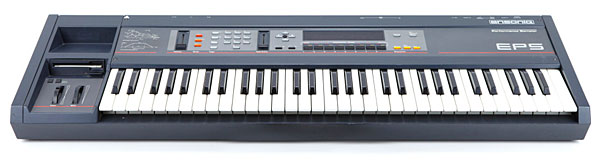
EPS means 'Ensoniq Performance Sampler'. The EPS is just that with clever new features that make it not just a professional studio music production tool, but also a powerful live performance instrument. Its biggest feature is its ability to load new samples while playing the instrument, a feature you'd be lucky to find on current synth/samplers. The EPS is somewhat multitimbral in that you can have 8 instruments on-line one at a time or stacked* and switching between them is as easy as pushing one of the 8 instrument buttons. The 'Patch Select' buttons over the Mod-Wheel allow for on-the-fly patch switching from a spot where your hand is likely to be while performing!
Its unique 13-bit sampler is highly versatile with multiple sample rates to choose from (6.25 to 52kHz). However, higher sample rates mean less polyphony and sample time. Unfortunately sample memory is miniscule at 480 Kb yielding anywhere from 5 to 41 seconds of sample time. Fortunately it is expandable up to 896 Kb (with optional 2x expander) or 2.1 Mb (with optional 4x or 4x+SCSI expanders) allowing as much 167 seconds of sample time. Some of the EPS's goodies include an 8 to 16 track sequencer (which steals its memory space from the same RAM that holds the samples) with quantizing, digital filters that seem like analog and preset template envelope options.
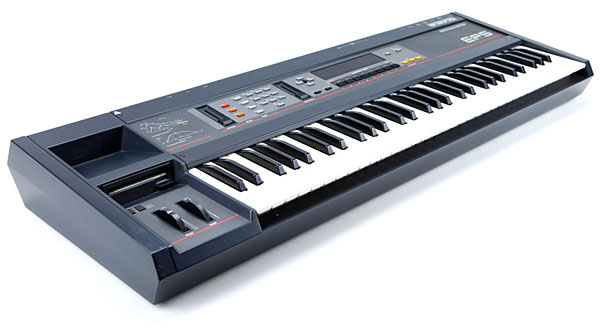
The EPS brought together many facets of synthesis at its time: sampling, synthesis and performance. It blended these together in a superb machine that, despite its limited sample memory, is quite popular and useful even today. Though it was later upgraded to the full 16-bit EPS-16+, the 13-bit EPS is a very cost-efficient alternative for any musician in search of classic keyboard-samplers!
* Although you usually play one instrument part at a time, you can get all 8 up at a time. With the EPS in Load mode by first selecting an instrument and then double clicking another instrument both will be played together. Continue double-clicking the other instrument buttons to layer all 8 instruments! (submitted by Rod Wesson and John Rule).
The EPS has been used by Cirrus, Wu-tang producer RZA and filmaker/composer John Carpenter.
You Might Also Like
Demos & Media
Audio Clip 1
Take a listen to the EPS-16+ for a good idea of the EPS sampler potential.
Specifications
Polyphony -
12 voices at 52 kHz.
16 voices at 39 kHz.
20 voices at 31.2 kHz.
16 voices at 39 kHz.
20 voices at 31.2 kHz.
Multitimbral -
8 parts.
Sampler -
Mono 13-Bit A/D input, 16-bit D/A stereo output. Variable sample rates from 52kHz to 6.25kHz; Sample-time: 5 seconds (52kHz) to 41 seconds (6.25kHz).
Filter -
Independent dynamic digital filter per wavesample, multi-mode digital low pass or variable-width band-pass with many slopes
VCA -
6-stage envelope including envelope preset templates
Sequencer -
8 tracks with separate instrument, volume, and MIDI channel. 80,000 notes limit.
Keyboard -
61 keys (velocity and aftertouch)
Memory -
512 Kb (480 Kb to be exact) internal (expandable to 896 Kb w/ 2x expander, 2.1 Mb w/ 4x expander)
Control -
MIDI, Disk Drive (800K double-sided 3.5" micro-floppy), SCSI (w/ 4x+SCSI expander)
Weight -
29 pounds (13 kilograms)
Date Produced -
1988
Websites of Interest
Resources
Images from Perfect Circuit Audio.