Ensoniq Fizmo
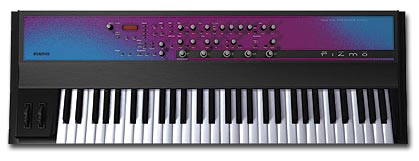
The Fizmo is a 48-voice synthesizer which uses 2nd-generation Transwave technology to create very organic sounds unlike any other synth available. Every programming function has its own dedicated knob or button, and there is a limited but useful 4-character LCD display. The Fizmo features an Arpeggiator and 24-bit VLSI effects with 41 algorithms, including a Vocoder and the ability to process incoming audio through the Vocoder and effects.
Transwave synthesis uses wavetables of sound data with layered variations in harmonic structures such that their timbres progress naturally from one end to the other. This allows for sounds to modulate over time, or by velocity, wheel, pressure, or any number of other options.
There are 2 oscillators available for each of the 4 presets allowing for 8 unique oscillators at the same time, not to mention individual LFO and Noise generators for each Osc. Another wonderful feature is the ability to stack up to four individual presets together into one sound and map them across the keyboard. This synth is very capable of some very complex sounds.
The built-in Arpeggiator has 118 presets which can be easily edited to your liking, and 26 real-time control/editing knobs make mutating your sound a pleasure. All controls may be recorded in real-time to an external sequencer.
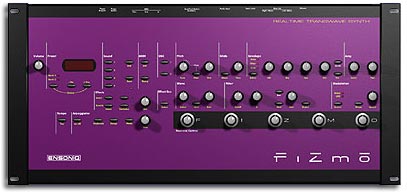
The Fizmo Rack is 5U rack-mount version of the Fizmo with more patches. The Fizmo will appeal to anyone who creates electronic music, particularly those into techno, trance, ambient or industrial. Sound designers and film composers would also enjoy this synth. The evolving motion and rhythmic patterns of its sounds created by the Transwave technology set this synth apart from the others. The Fizmo has been used by Eat Static.
You Might Also Like
Demos & Media
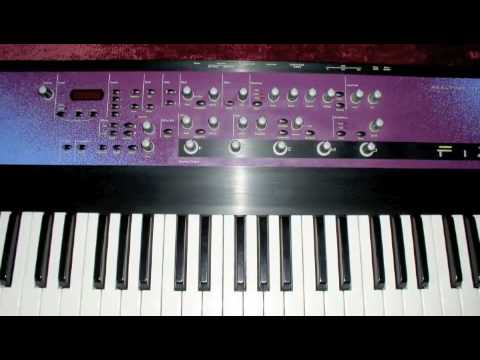
Ensoniq Fizmo all by itself :-)
Audio Clip 1
Demos of various patches. From Future Music CD issue 81.
ManualDownload the original owners manual here.
Specifications
Polyphony -
48 voices
Oscillators -
4 MB of 16-bit internal wave ROM, featuring Transwaves (created through digital synthesis and resynthesis technologies); 2 osc for each of 4 presets - total of 8 simultaneous - 58 waveforms
LFO -
8 LFO's (7 waveform choices, can sync to Arpeggiator or external MIDI clock)
Filter -
Resonant LP & BP 4 pole filters. Non-Resonant 2LP+2HP, 3LP+1HP, 2LP+2LP, 3LP+1HP filters.
Effects -
41 digital VLSI 24-bit effects (8 Global Reverbs, Chorus, Flanger, DDL, Distortion, Tunable Speaker, Chatter Box, Vocal Morph, Auto-Wah, Vocoder); Processes incoming audio
Keyboard -
61 semi-weighted keys (velocity and channel pressure sensitive, 4 programmable key ranges, 4 possible zones)
Memory -
128 ROM sounds, Up to 128 RAM, 64 Presets
Control -
MIDI (up to 4 polyphonic channels)
Date Produced -
1998
Websites of Interest
Resources
Images from E-mu/Ensoniq.
Thanks to Matt Winrick and to E-mu/Ensoniq for providing information.