Red Sound Systems DarkStar
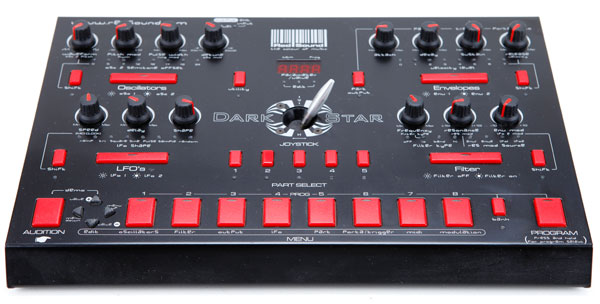
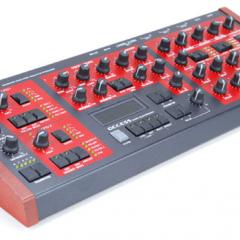
British company Red Sound System's first synth, the DarkStar is a table-top 8-voice polyphonic synthesizer suitable for anybody who wants affordable analog sounds for use in most any style of electronic music. Analog sounds are created by DSP-based analog modeling which means you'll get reliable and clean analog-type synth sounds in an economical and professional instrument. The DarkStar features 2 oscillators per voice, 5-part multitimbral set-up, joystick mixing for oscillators, ring modulation, filter resonance and pink/white/blue noise generators.
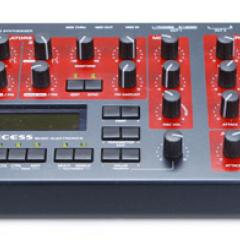
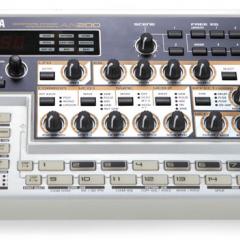
Its unique look is modeled after RSS's other DJ tools. There are 14 knobs, all of which transmit MIDI data and provide instant hands-on access to the filters and envelopes. The two LFOs and two envelope generators provide plenty of modulation abilities for the oscillators, pulse-width and filter. The filter offers high-, low- and band-Pass filtering with a 12dB/oct slope. It's not spectacular, but it is fairly flexible since both the cutoff and resonance can be modulated by either LFO and EG for a wide range of filter-sweeping effects.
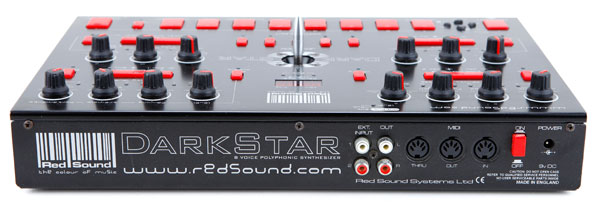
The DarkStar has a simple yet powerful upgrade system as well. By simply plugging-in an EPROM chip into a compartment on its underside you can get an entirely new synth such as a vocoder or mega-mono synth. The DarkStar certainly has some interesting concepts and good sounds at a very affordable price, though this low price may be noticed in the construction and design of the machine. Still it may just be too good to pass up if you're on a budget!
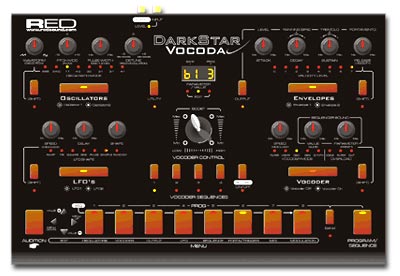
An optional upgrade kit converts the DARKSTAR into the VOCODA - a fully featured vocoder with five operating modes. Featuring 11-band filtering / noise generation, this simple EPROM chip D.I.Y. upgrade will allow you to combine external sounds (voice or loops) with an external sound source for classic vocoder sounds, that's the Standard Vocoder mode (1). Use the DARKSTAR's internal osc. and 'S' detector for true 'robotic' style vocoding (2). The Filter Mode (3) can be used to process any stereo signal through the 11-band stereo filter for cool filter sweeps. The Sequence-coder Mode (4) and Synthesizer Mode (5) use the 8-step formant sequencer to control the vocoder filters on external sounds or the internal oscillators. Additional MIDI envelope control, vocoder phrase step-recording, 15 preset vowels via sound palette, and more! Upgrade kit includes VOCODA decal for DARKSTAR.
You Might Also Like

Demos & Media
Audio Clip 1
A series of demo patches in which the filters and ring-mod get swept over time thanks to its flexible modulation abilities.
Audio Clip 2
A few demos of the vocoder effect on vocals and drum loops.
Specifications
Polyphony -
8 voices
Oscillators -
2 per voice (Osc 1: continuously variable between Sawtooth and square/pulse; OSC 2: Formant or pink / white / blue noise); hard sync-able
LFO -
2 with separate speed and delay controls (Ramp, Triangle, Square, Sine, Pulse, Sample & hold, Random waveforms); MIDI sync-able
Effects -
Auto-Panning, Tremolo, Fixed frequency Ring Modulation, Portamento
Filter -
12dB/oct resonant with low-, high- and band-pass
Keyboard -
None
Memory -
64 patches
Control -
MIDI (5-parts)
Date Produced -
1999
Resources
Images from Perfect Circuit Audio and Red Sound Systems Online.