Alesis NanoSynth
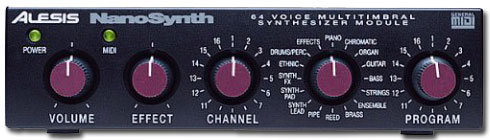
The NanoSynth is probably the 'fattest' little Nano-anything in the world! Unlike Alesis's other Nano-modules which offer 256 preset sounds, the NanoSynth doubles that to 512 and adds another 128 of user-programmable patches - a first for the Nano-modules. It also added stereo audio inputs and a built-in serial RS232 jack for direct Mac or PC connections, and full 16-part multitimbral operation.
As it's name suggest's, the NanoSynth is a compact MIDI module designed to give you ready-made 'Synth' sounds that should cover just about every musical style! From the front panel you can call up only the 128 User programs and the 128 General MIDI presets. The other 384 unique NanoSynth presets can only be called up via MIDI or serial link. External MIDI Editor/Librarian software must be used to edit the Presets and create User patches.
The sounds in the NanoSynth are pretty darn good too. They are based on the same synthesis engine as the QS synths. There are even built-in effects, also based on those found in the QS synths. With 64 voices and 16-part multi-timbrality, this tiny box (for less than $200) can do it all - drums, synths, guitars, pianos, organs, strings, pads, leads, etc. It makes a nice 'grab-bag' of sounds but wasn't designed to satisfy those looking to create their own wildly unique or complex synth sounds and textures.
Update: The Nanosynth has 64 part multitimbrality and 16 MIDI channels. Ideally, it can play 64 sounds independently. It is a full quadrasynth in a side pocket.
You Might Also Like
Demos & Media
Audio Clip 1
Demos of various patches. From Future Music CD issue 66.
Specifications
Polyphony -
64 voices
Oscillators -
16-bit 48kHz linear sample ROM
LFO -
3 LFOs
Filter -
Sweepable Lowpass filter
VCA -
3 Envelope Generators
Keyboard -
None
Memory -
640 Programs (512 preset, 128 user)
Control -
MIDI (16-parts multi-timbral)
Date Produced -
1997
Resources
Images from Alesis.