Siel Mono
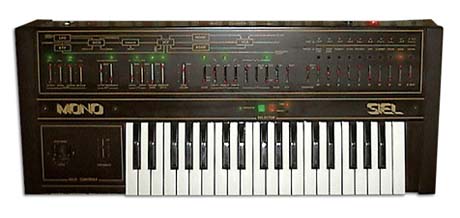
The Siel Mono is an analog monophonic instrument from an Italian synthesizer company. It is both a Preset-style synth as well as a single oscillator subtractive synth. Although it may seem inconspicuous, it is surprisingly flexible, easy to use and really sounds quite good.
There’s just a simple row of sliders for adjusting all of its parameters. However, the panel layout of all the controls is a bit unconventional compared to traditional synthesizer signal flow (it starts with the ADSR and ends with the oscillators). Also, most of the controls are split up, with some of the filter, envelope and LFO controls on the left side of the panel, and additional controls for these sections in the middle of the panel (perhaps Siel thought the controls a player would want to tweak during a performance should be where the left hand could easily find them). And then there is the signal-flow diagram printed along the top of the front panel which is in a more typical layout and results in the unfortunate caveat that the control sections do not line up with their equivalent representations in the signal flow diagram directly above them. But that should not really matter to any experienced synthesist.
Moving from left to right, the Mono starts with the envelope ADSR sliders which can be assigned to either the (VCA) amplifier, the (VCF) filter, or both the VCA and VCF at the same time (although the assignment switch for the ADSR is located in the middle of the synth rather than next to the actual ADSR controls). Next comes the VCF (filter) with only Cutoff and Resonance sliders. The filter can be switched between Lowpass, Bandpass and Highpass modes (this switch is located in the middle section of the keyboard). Next up is the LFO section which only offers one sinusoidal wave-shape with Depth and Rate sliders. Yet again, the remaining controls for LFO on/off, Delay amount, and destination (the DCO or the VCF) are located in the middle area of the panel. Next up is a Noise generator Mix slider (and you guessed it, the on/off switch is located elsewhere, in the middle bank of sliders), and an "Animator" Depth slider.
Next we get to the middle section of the front panel which has sliders for overall volume output and all the supplementary ADSR, VCF, LFO and Noise generator controls previously mentioned. There is also an enable switch for the "Animator" effect which is sort of like a vibrato.
Finally we make it to the oscillator or sound bank section. There are two operating modes for the Mono: Preset or Free. In Preset mode, you can select from Bass Tuba, Trombone, Trumpet, Flute, Picolo, Sax, Clarinet, Violin, Bass and Guitar. Not all editable parameters may be available for some sounds, so when a Preset is selected, an LED is illuminated over each section that can be edited. In Free mode you have basic waveforms to choose from including sawtooth or square waves. Of course, there is no user memory available so any custom sounds or manipulated Preset sounds can not be stored.
The remaining controls are located next to the 37-note keyboard: a joystick-like Pitch-bender and Portamento (over one octave) controls. The Mono is pre-MIDI, and unfortunately it also lacks any sort of CV/gate type interfaces as well, so you won’t be able to use it with any sort of sequencers - hardware or software, analog or MIDI-CV devices. There are no MIDI retrofit kits either.
Ultimately the Mono sounds great and has an uniquely warm, Italian flavor. Yes, its controls are easy enough to edit and understand. But the unusual (dis)organization of the parameter sliders does take a little getting used to, and the lack of any sort of external control options is unfortunate. Still, it makes an inexpensive and very unique alternative to the more common mono-synths from Moog, Roland, ARP and Korg.
You Might Also Like
Demos & Media
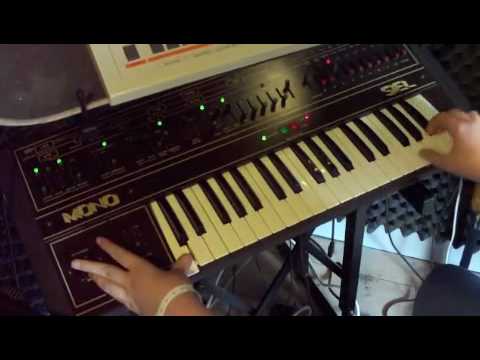
White Jack - I Love Winter (Solo Outro Improvisation)
ManualDownload the original owner's manual from SoundProgramming.net.
Specifications
Polyphony -
Monophonic
Oscillators -
1 DCO + Noise generator
LFO -
1 sinusoidal LFO with rate, depth. Can be assigned to DCO or VCF.
Filter -
1 VCF with Lowpass, Bandpass and Highpass modes and ADSR envelope
VCA -
1 VCA: ADSR
Keyboard -
37 keys (no velocity)
Memory -
10 presets: Basso tuba, Trombone, Trumpet, Flute, Piccolo, Sax, Clarinet, Violin, Bass and Guitar.
Control -
None
Date Produced -
1980
Websites of Interest
Resources
Images from Synthesized Dreams.
Review updated January 2011