SoundMaster Stix ST-305
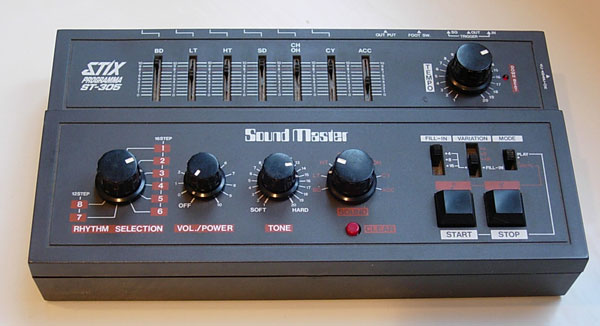
When the BOSS DR-55 appeared, it was the first affordable drum machine featuring programmable patterns rather than presets. It soon had a competitor in the form of the SoundMaster SR-88, which was so similar in appearance and sound to the DR-55 that it might make you wonder why Roland didn't sue SoundMaster out of existence. Roland clearly didn't, as the SR-88 was followed by the ST-305 "Stix". In terms of features and sophistication the Stix is somewhere between the BOSS DR-55 and Roland TR-606, with programming like the DR-55 and individual volume controls for each instrument like the TR-606. While it was soon eclipsed by the TR-606, which featured a higher number of patterns and the ability to chain them together into songs, the Stix does offer individual audio outputs for each sound. There is also a trigger input and two trigger outputs - one a constant clock pulse and the other programmable via the accent.
The sounds on the Stix are limited to kick, snare, high tom, low tom, closed high hat, open high hat and cymbal. There is also the accent, which has its own level control and affects all instruments on each beat it is applied to. Patterns are limited to six with sixteen steps per bar, and two with twelve steps per bar. Each pattern can be programmed as a single two bar pattern (A and B) or as two one bar patterns (A or B). In addition to playing one bar repeatedly or both in succession, there's also a "fill in" mode, where bar A plays repeatedly until bar B plays once at the end of every four, eight or sixteen bars.
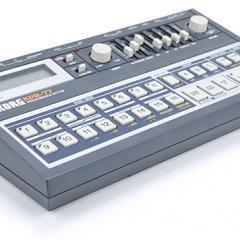
Overall the Stix is a fun machine despite its limitations. It has a subtly different character to the contemporary Roland TR-606 and Korg KPR-77, while also benefiting from separate audio outputs as standard. It's unlikely that anyone has used the Stix on a really famous recording, but the cheap price of the SoundMaster drum machines probably means that many electronic musicians learnt their craft on one!
You Might Also Like
Demos & Media
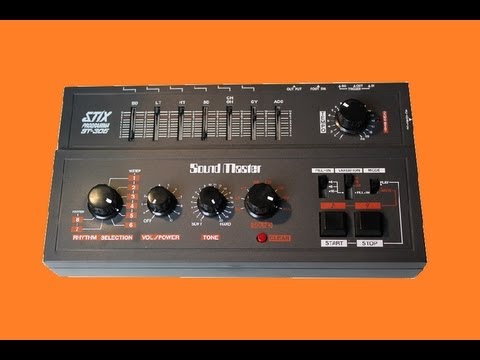
SOUND MASTER STIX ST-305 Analog Drum Machine
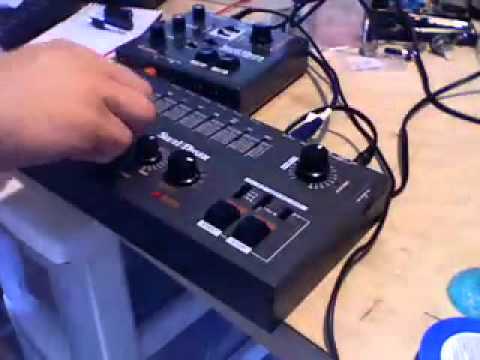
Soundmaster Stix ST-305 vs SR88
Audio Clip 1
A brief demo of the Stix.
Specifications
Polyphony -
6 Tones
Sequencer -
16-step sequencer with Fill-in and Variation effects
Patterns -
8 programmable rhythm patterns (six 16-step, two 12-step)
Songs -
None
Effects -
Accent
Keyboard -
None
Memory -
8 rhythm patterns
Control -
Trigger IN/OUT
Date Produced -
1981
Resources
Image & review by Chris Wareham
Reviewed November 2009