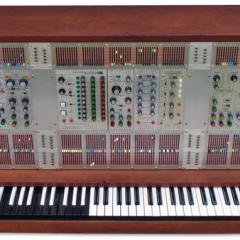
Electronic Music Studios (EMS) Synthi A
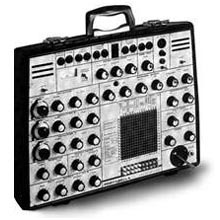
Synthi A
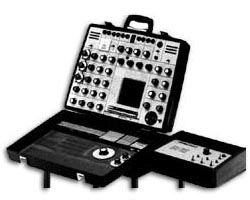
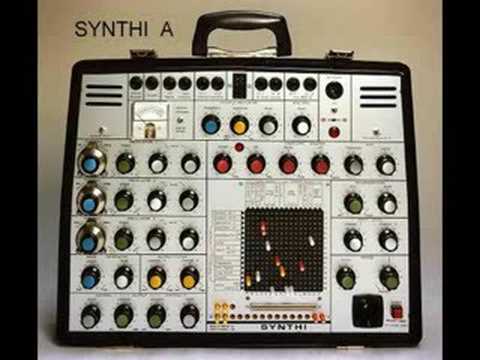
The Synthi A and Synthi AKS models are virtually the same electronic instrument as the EMS VCS3, except that the Synthi models are housed in a thin plastic briefcase for easy portability. The Synthi A was also commonly known as the "Portabella". The AKS model (pictured below) adds a 256-step on-board monophonic digital sequencer and a 30-note touchplate keyboard (activated by the 50 Hz-hum in our fingers).
Like the VCS3, the Synthi A and AKS feature three oscillators and a unique patch system. Instead of patch wires, they use a patchbay grid wherein the synth components are laid out and signal routing is accomplished by placing small pins into the appropriate slots. The VCS3/Synthi was, in actuality, a modular type synthesizer reduced down to an extremely portable size.

Synthi AKS
They are famous for their ability to generate those familiar sci-fi sounds (Dr. Who) and other uniquely analog sounds. After ten minutes of warm-up the oscillators become pretty stable. There's a Noise Generator, two Input Amplifiers, one Ring Modulator, one Voltage Controlled Low Pass Filter (VCF), one Trapezoid Envelope Generator, a Joy-Stick Controller, a Voltage Controlled Spring Reverb unit and two Stereo Output Amplifiers.
What is important about the portable line of EMS synths is that they were super miniaturized and fairly sophisticated for their time. The patching grid system made patching easier, and allowed the unit to take up a lot less space. The Synthi A was released in 1971, two years after the launch of the VCS3 (The AKS came out in 1972). It should be noted that the case mounting of the AKS can be very precarious. The mounting is prone to fail, and therefore any used units should be examined carefully to see if this common problem exists before buying.
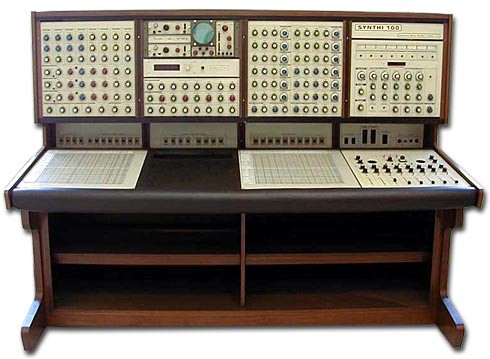
Synthi 100
EMS also produced the monsterous Synthi 100 in 1971. It is loosely based around the combination of three VCS3 systems into one massive synthesizer. Although the circuit boards are unique and somewhat different, the filters are still quite similar to those of the VCS3 and A/AKS. The sound of the Synthi 100 was subtly distinct from the VCS3. Both filters and oscillators were much more stable in the Synthi 100. It featured twelve VCOs, two keyboards and a 3-track, 256-step monophonic digital sequencer. EMS really was an early pioneer of digital sequencers in a time when such devices as Moog's analog 10-step sequencer were the more popular norm. The Synth 100 also featured two massive 64 x 64 patch matrices. Approximately 29 Synthi 100 systems were built in the 1970s and early 80s, although EMS still states that you can have one built as a special order. It sold for $25,000 originally, and probably still does today. Jack Dangers of Meat Beat Manifesto owns one which he used heavily on his album, "R.U.O.K?".
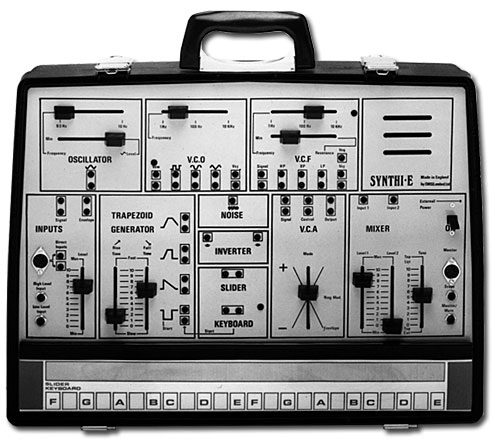
Synthi E
The Synthi E is an educational form of the Synthi that had a complete teaching course built around it for use in colleges and schools. It was intended as a teaching aid into the principles of sound synthesis and electronic music. Small, housed in a brief-case and battery powered, the Synthi E was perfect for the student or teacher on the go! Simple as it may appear, it actually has some sophistiated features:
- Input Amplifier with low (Microphone) and high (line) level inputs.
- Envelope Follower providing a voltage proportional to the amplitude of the input.
- Oscillator 1 with true exponential voltage control of frequency and three simultaneous output waveforms (sine, triangle and voltage controlled pulse).
- Oscillator 2 for slow control voltages such as glissando or vibrato.
- Filter/Oscillator 3 with v.c. low, high and band pass filter or pure sine wave.
- Modulator for envelope shaping or ring modulation. Noise Generator.
- Trapezoid Generator for multiple simultaneous trapezoid waveforms. These may be used for envelope shaping (trigger mode) or for low frequency waveforms (free run mode).
- Manual-Slide tape Controllers (2) for obtaining control voltages. One slide-tape is stepped and may be used as a keyboard and the other for variable control. One provides a trigger pulse. Both may be temporarily marked or written on.
- Inverter to invert control voltages or signals.
- Monitor Amplifier and Loudspeaker with two input mixer faders.
- A 3-octave keyboard for controlling the Synthi E is available. This unit is a mechanical keyboard which plugs into the Synthi E. It provides the correct pitch voltage and trigger signal for the Trapezoid Generator. A switch on the Synthi E selects internal or external keyboard operation.
Many of these EMS synth's have been used by Brian Eno, Pink Floyd, Stereolab, Yes, Aphex Twin, Autechre, Jean-Michel Jarre, Astral Projection, Vince Clarke, The Who, Todd Rundgren, Recoil, Freddy Fresh, Ultravox and many more.
You Might Also Like
Demos & Media
Vintage Synth Demo - EMS Synthi
Audio Clip 1
Hear the VCS3 in action. These are some weird electro-synth sounds from it.
Specifications
Polyphony -
Monophonic
Oscillators -
9 to 12 oscillators
Filter -
Low Pass VCF
VCA -
Trapezoid waveshape Envelope generator
LFO -
Yes
Keyboard -
Synthi AKS has a 30-note touchplate keyboard.
Memory -
None
Control -
CV/GATE
Date Produced -
Synthi A - 1971
Synthi AKS - 1972
Synthi 100 - 1971
Synthi A - 1971
Synthi AKS - 1972
Synthi 100 - 1971
Websites of Interest
Resources
Images from 120 Years EMS Synthesizers
Additional information provided by Henry Warwick, Charles Mitchell, DAC Crowell, and Geoffrey Feldman.
Review updated May 2009