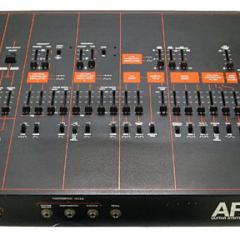
Moog Minimoog Voyager
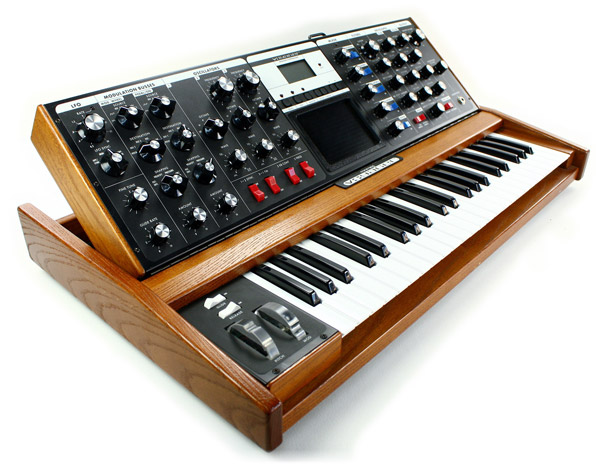
Minimoog Voyager Performer Edition
The highly anticipated Minimoog Voyager synthesizer has arrived! This masterpiece of a synthesizer marks two landmarks in the history of synthesizers: the rebirth of the Minimoog and the return of Moog Music! Dr. Robert Moog himself helped design this modern-day Minimoog along with Big Briar. Big Briar (formed by Dr. Moog in 1978) became popular in the nineties with their Moogerfooger analog effect boxes and Etherwave Theremins. In 2002, Moog got the rights back to Moog Music so Big Briar (and all its products) are now Moog Music.
Moog Music introduced the Minimoog Voyager synthesizer in two editions: the Signature Edition and the Performer Edition. There were only 600 Signature Edition models and they listed for $3,495 each! Their unique features include: Hand-finished wood cabinet in your choice of genuine solid maple (light), cherry (honey-colored), or walnut (brown), illuminated, clear acrylic Pitch Bend and Modulation wheels, gold-plated nameplate, padded Gig Bag, 4-year warranty with two free factory tunings, and is individually inspected and signed by Bob Moog. The Performer Edition listed for $2,995 and has a solid hardwood cabinet.
The Minimoog Voyager is a true analog monophonic synthesizer (probably the most expensive one of its kind) and is based entirely on the original classic Minimoog Model D, which was produced by Moog Music, Inc. from 1970 to 1982. It introduces many new features, including a three dimensional touch pad, MIDI I/O, extensive patching facilities, patch storage, and more! It's cased in a beautiful, solid hardwood cabinet with a multi-position hinged control panel.
Just like the original, the Voyager has three analog wide-range voltage controlled oscillators, one noise source, as well as one audio preamplifier for externally-applied audio signals. Two resonant Moog-style filters are on-board and function in dual lowpass or lowpass/highpass modes and can be modulated by one of the two ADSR envelopes, the LFO, or external control. All knobs and switches can have their settings stored into one of 128 Program memories. Program Banks as well as the Voyager's Operating System can be uploaded/downloaded via MIDI SysEx. Centered on its front panel is the ominous, black 3-D (XYZ) Touch Surface which provides three continuously-variable control signals which are derived from the up-down and left-right position of the player's finger, and the amount of area with which the player makes contact to the surface.

There's also a 44-note keyboard, this time with velocity and aftertouch sensitivity. Also on-board are Pitch and Mod wheels, Glide/Portamento, and a series of 1/4" CV and/or Pedal jacks lining the top/rear of the front panel. The Mod Wheel can be sent to control all oscillators, or just VCO2, VCO3, the filter cutoff, or LFO rate. The Mod can gets its source from the LFO (triangle/square/sample-n-hold waveforms), VCO3, or the external Mod2 input. A Mixer Module gives you a five-input mixer for combining various audio sources prior to filtering between the oscillators, noise and external audio input signals.
The new Minimoog Voyager is a first class synth; every bit as elegant in look as sound and quality. It is highly streamlined and offers all the functionality of a modern day (mono)synth with the classic, warm, unforgettable Moog sound. It WILL replace your original Minimoog (if you're lucky enough to have one). Signature models will become prized possessions for decades to come, and the Performer models will prove to be major players in future of music to come!! It's being used by Stevie Wonder, Maroon 5, the Crystal Method, Electric Skychurch, Duran Duran, Air, Morcheeba, Black Eyed peas, Nine Inch Nails, Blues Traveller, Red Hot Chili Peppers, Dido, The Cure, Herbie Hancock, Rick Wakeman, Yes, Nickelback, Dream Theater, Paul Simon, Joy Electric, the Neptunes, Alicia Keys, CeeLo Green, Madonna, Incubus, FUN, Radiohead, Bjork and more!

Minimoog Voyager Rack Mount Edition
Minimoog Voyager Rack Mount Edition (2005) packages the Voyager into a 19" 5U rack mount / table-top version. The Voyager RME contains all the synthesis functions of the original Voyager and includes the Electric Blue backlit panel introduced with the Anniversary Edition Voyager from 2004. New features include a switchable output mode (balanced/unbalanced) and an Input Accessory Port for CV/Gate Inputs. Up to 16 RME Voyagers can be linked together to achieve polyphony. The RME listed for $2,795.

Minimoog Voyager Electric Blue
Minimoog Voyager Electric Blue (2006) is based off the limited run of the 50th Anniversary Edition Voyagers from 2004-05, which featured a black painted wood cabinet and the control panel was backlit using electroluminescent technology. The Electric Blue models which have been sold since 2006 continue to feature the electric blue backlit panel and is housed in a fractal blue solid ash cabinet and lists for $3,556.
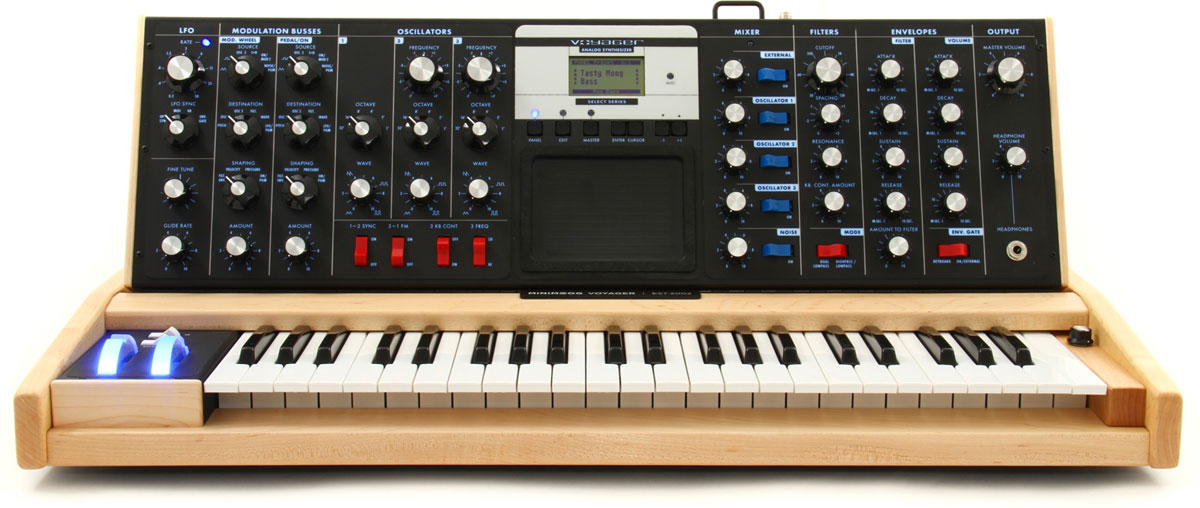
Minimoog Voyager Select Series
Minimoog Voyager Select Series (2006-13) was a customizable version of the Electric Blue in which the customer can choose between mahogany, electric blue, traditional ash, white wash, maple, black, cherry, and walnut cabinets with red, blue, white, orange, green, or purple backlighting. They listed for $3,659 but were reduced to $2,999 when discontinued in 2013.
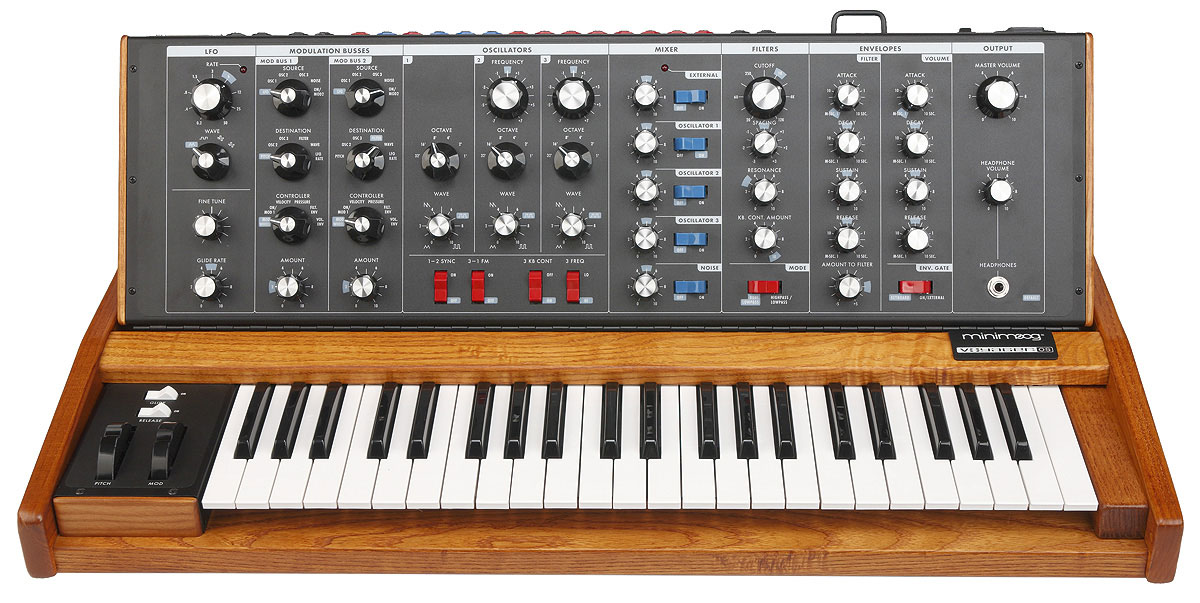
Minimoog Voyager Old School
Minimoog Voyager Old School (2008-09) looks like a traditional 1970's Minimoog. The Old School is focused on traditional features, dropping digital controls and leaving behind a pure analog sound engine. The central touch pad controller and LCD screens are gone. It has expanded modulation capabilities beyond that of the previous Voyagers (more patchable sources and destinations). MIDI I/O is absent, but it has pitch CV out and keyboard gate CV out. It was only available in the "Traditional Ash" wood panelling and listed at $2,695. Billed by Moog as the perfect replacement for the Minimoog Model D. The Old School was discontinued in 2009.

Minimoog Voyager XL
Minimoog Voyager XL (2010) was released in celebration of the 40th anniversary of the Minimoog Model D. It adds to the Voyager an expanded 61-note keyboard, a ribbon controller, an additional LFO/modulation bus, and most notably, an extensive front-panel analog patch bay that opens the Voyager up to a more modular approach to creating sounds with more flexibility than any previous Voyager model. The XL listed for $4,995.
You Might Also Like
Demos & Media
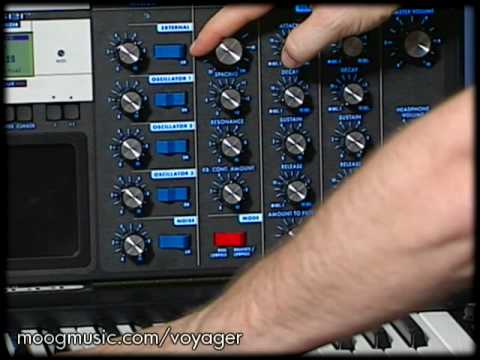
Instructional video on its filters.
Specifications
Polyphony -
MONOPHONIC (switchable between low note, high note, or last note priority)
Oscillators -
3 wide-range analog oscillators with triangular, sawtooth, square, and narrow rectangular waveforms.
LFO -
One LFO (VCO3 can be used as a 2nd LFO) with triangular, square, Sample & Hold, and smoothed Sample & Hold waveforms. Adjustable Rate speeds from 0.2 Hz to 50 Hz. LFO Syncable to keyboard gate, external envelope gate, or external gate.
Filter -
Two analog filters: Dual Lowpass mode or Highpass-Lowpass mode. Cutoff, Resonance, Keyboard Control Amt, Spacing (sets the spacing between the frequencies of the two filters over a +/-3 octave range). One wide-range ADSR (Attack Decay Sustain Release) envelope generator.
VCA -
One wide-range ADSR (Attack Decay Sustain Release) envelopes for the stereo amplifier.
Keyboard -
44 keys with Velocity and Pressure control. Pitch/Mod wheels (illuminated blue on Signature Edition).
Memory -
128 programs. All front panel controls, selectors, and switches are stored in the nonvolatile digital memory.
Control -
MIDI IN/OUT/THROUGH, CV/GATE, Pedal/CV inputs for: Volume, Pan, Filter Cutoff, Waveform select, Pitch, Mod1, Mod2, Sample n Hold, Env Rate, LFO Rate, and Sync.
Date Produced -
2002
Websites of Interest
Resources
Images from Perfect Circuit Audio, SweetWater and Sound on Sound.
Review updated February 2013.