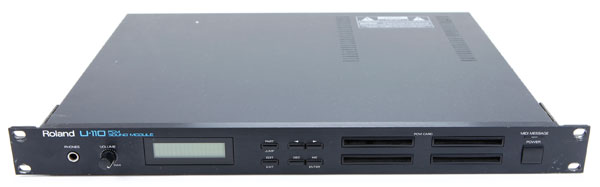
Roland U-110

Roland U-110 Image

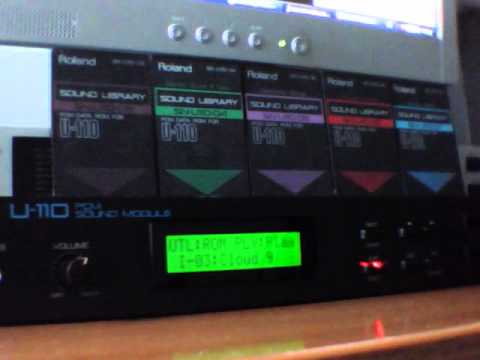
The U-110 is a basic rack-mount sound module consisting of acoustic-oriented PCM samples with preset settings, limited flexibility, and boring late eighties sounds. It's nothing to get excited about. It has 2MB of ROM-based sampled sounds, none of which sound great. The U-110 is fairly noisy as well. Its palette of sounds could be grossly expanded with up to four expansion cards, but good luck finding those today!

The U-110's biggest distinction, really, is that it was Roland's first totally digital sample-based synth. At the time, that was a break-through - look at all the realistic sounds you get in a single rack space MIDI module! Nowadays, it's hard to wonder why anybody would want one of these. The U-110 was available in a prototype form as the T-110. But the U-110 was soon replaced by the U-20 keyboard and U-220 module. Astral Projection used a U-110 before they switched to the U-220.

27 Visitor comments
LeGrosChat
March 18, 2013 @ 11:47 pm
I agree with the last comments : for me one of the finest sound of piano I've ever programmed, but needs some dive in the sub menus to find the way to build it at its best...
I don't use mine as a multitimbral unit, but in a smart "layering" mode, using velocity and aftertouch ranges to control the balance between the different layers on separated outputs with FXs on a mixer. That way, it becomes a real incredible beast, so rich, versatile and expressive... So far as people think a quite simple old ROMpler like that can do !
Deckard Replicant
March 13, 2013 @ 8:00 pm
WOW. this site rates this unit a 1???? it is no JV1080 but it is not garbage. This unit is capable of very good sounds and I use it often enough. it is a solid 3 rating by my standards. proudly part of my synth lineup. It has some gorgeous string and brass sounds.
mbl
February 15, 2013 @ 8:04 am
the partials need to be carefully programmed for best results. the u110 sounds easily compete with the fantum providing you know how to program the synth. there is an incredible level of programming hidden within sub menus use them as designed and the sound is truly amazing. the string sounds are as good as any. most users dont bother taking the time to learn how to operate synths and think they are rubbish when they are real gold. just because its old doesnt mean its no good. its possible to arrange complete orchestral symphonies using these units.
magicbyhand
November 1, 2012 @ 5:19 pm
Learned by passage of time: When the U-110 internal memory battery begins to die, it will still hold patches, BUT the aliasing at tails of decaying sounds and the overall noise floor go way up in volume. Fortunately, this is one of the easiest modules EVER for changing the battery -- simply remove several screws holding the case on, slide the lid off, and the battery sits in a t-shaped spring-loaded holder. Slide out the old battery, slide in the new one, close the case, and hit reset as instructed by the manual. Much better!
magicbyhand
September 11, 2012 @ 10:39 am
This is a much better unit than most have indicated. I have 14 of the 15 add-on cards, and they add much flexibility to the unit. The architecture is a bit convoluted, but not bad. The much-criticized noise is very minor, and lost in a mix. When put in a system with a D-110, 6 midi channels can come from this U-110 rompler and 9 midi channels from the D-110 linear arithmatic synth. This leaves one midi channel for the live keyboard, giving you sample and synthesis and massive multiple outputs from only three units. As cheaply as they come these days, do give it a try.
 
Post Comment!
VSE Rating

Don’t bother

User Rating

Rated 3.1 (141 Votes)

  • Demos & Media
  • YouTube Thumbnail
    Video 1
    - Roland u-110 rom play demo

    Manual - Roland has made manuals for most of their products available as free PDF downloads.

  • Specifications
  • Polyphony - 31 voices (6-part multi-timbral)
  • Oscillators - 2MB ROM samples, expandable to 4MB
  • Multitimbral - 6 parts
  • Filter - None
  • Envelopes - Amp envelope attack/release can be edited, among the limited parameters.
  • Effects - 2 FX - chorus and auto-pan.
  • Memory - Expandable with PCM cards: Up to 4 cards can be used simultaneously.
  • Keyboard - None
  • Control - MIDI
  • Date Produced - 1988

Errors or Corrections? Send them here.