Akai • AX-80

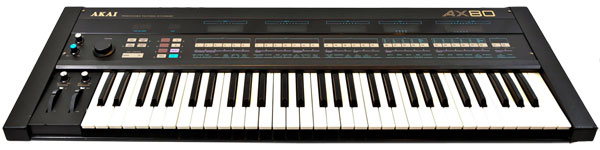
Akai AX-80 Image

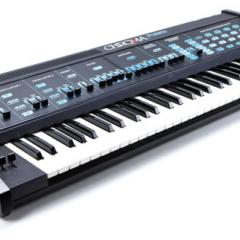
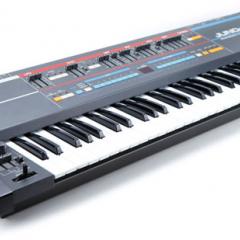
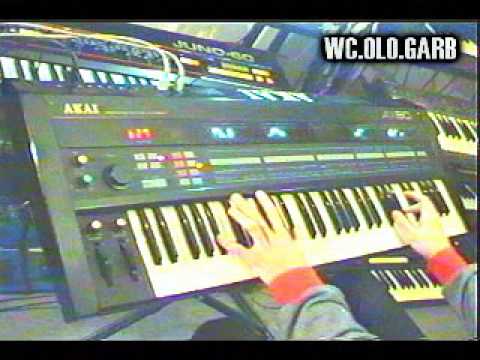
The AX-80 has the privilege of being the first pro-keyboard produced by Akai, released in 1984. It's an eight-voice programmable analog synthesizer with a full 61-note keyboard and a series of techno-looking LCD bar-graph displays running across the top of the keyboard. Two analog oscillators per voice plus a sub oscillator provide the basis of its punchy analog sounds that can be described as similar to a Chroma Polaris or Roland Juno 106. Very good bass, brass, synth sounds, and effects are possible. However its strings are average at best.

The blue and orange florescent LCD displays use a simple and intuitive bar-graph format to show all its parameters and values, making for one of the best on-board displays ever! You have to wonder, however, with such a cool display, why couldn't they have included dedicated sliders and knobs for each parameter (see the AX-60). A decent amount of patch storage and nice enough sounds make the AX-80 a useable synth to have around, but it probably won't replace your Roland Juno. Other notable features of the AX-80 include an angled rear panel for easy cable connections, chord memory, MIDI control, and pitch/mod wheels. It's been used by Mark Bell (LFO) on Bjork's Homogenic.


VISITOR COMMENTS

Comments page 6 of 6
Click here to add a comment
Peter
Posted Yesterday
The AX80 is an analog beast! It does not sound anything like a Juno 106!!! I own both, and that is truly a misconception. The AX80 sounds very similar to the Oberheim Matrix 6. I can recreate many of the presets in my Matrix 6 on the AX80. The Akai lacks all the matrix modulation routing possibilities of an Oberheim, but the filter is very similar. The Matrix is a bit warmer and smoother, but the AX80 has a real tough, thick sound! Great for powerful bass synths and analog effects. Very underrated analog synth!
Will
Posted 6 days ago
I came really close to selling my AX-80...until I sat down and started making patches. Now I can hardly get myself to turn it off! Of all the synths I own, this one has a dirtyness that (while not for everybody) really stands out. On top of that, it's user friendly like few others. I predict that when people get tired of vst's, overpiced analogs and teeny pop VA's, vintage synths like the AX-80 will be in style.
Nev
Posted 12 days ago
Of course it doesn't sound as warm as a Juno. It hasn't got a crappy little chorus effect built-in to cover up its thin, weedy sound. What it has got, though, are two oscillators, two ADSRs and three LFOs. If the AX80 isn't 'warm' enough for you, buy a chorus pedal!

If - like rather a lot of so-called analogue fans - all you're really interested in are the Juno's overused presets, modern digital synths (and a lot of home keyboards) have them in ROM. If it wasn't for the user interface, the AX80 would be right up there with the JP8. It can create complex patches that only a modular can beat.
Reverend Sunrise
Posted 23 days ago
Just starting to settle in with this sleek little black puppy and I dig it's sound. Like others have said tweaking on the fly live is difficult, but programming beyond the budge-ass presets yields some funkdafied results. Love the basses, complements my Pro One and Mini nicely, and the triple action eg's and lfo's allow for some interesting pad, string, and industrial-esque love. Much more fun to play than my Juno, and more bite than a JX. Have owned a Prophet 5, Andromeda, Jupe 6, CS-60, etc., and the Ax-80 ain't no jive talkin' [beep] as far as polys go. Definitely my thang.
Ian
Posted 36 days ago
I guess it doesn't hurt to say it again. This synth is not an average sounding synth. If you want that classic warm Juno sound this is a lost cause. I find this synth to sound very bitty and aggressive. It has an awesome layout though it is impossible to do heavy tweaking live. Despite all this it can always fill a spot in a mix that none of my other synths can. The AX80 is a valuable asset to any enthusiast willing to spend some time programing this analog beast.
 

infoRatings


Demos & Media


Specifications


Resources