Akai AX80

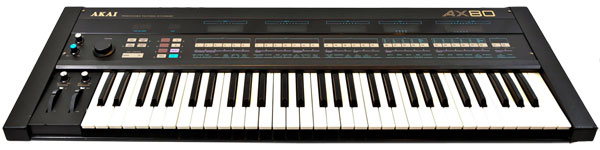
Akai AX-80 Image

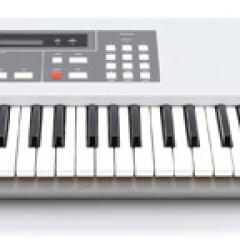
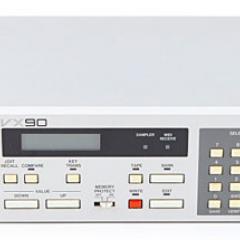
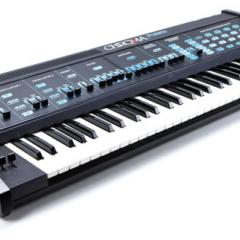
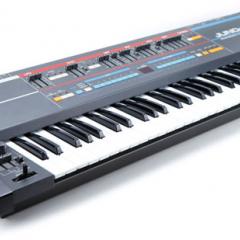
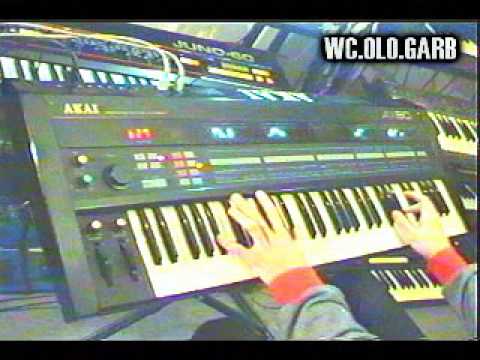
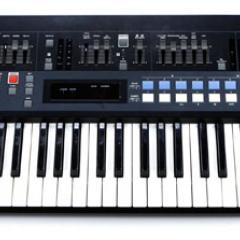
The AX80 has the privilege of being the first pro-keyboard produced by Akai, released in 1984. It's an eight-voice programmable analog synthesizer with a full 61-note keyboard and a series of techno-looking LCD bar-graph displays running across the top of the keyboard. Two analog oscillators per voice plus a sub oscillator provide the basis of its punchy analog sounds that can be described as similar to a Chroma Polaris or Roland Juno 106. Very good bass, brass, synth sounds, and effects are possible. However its strings are average at best.

The blue and orange florescent LCD displays use a simple and intuitive bar-graph format to show all its parameters and values, making for one of the best on-board displays ever! You have to wonder, however, with such a cool display, why couldn't they have included dedicated sliders and knobs for each parameter (see the AX60). A decent amount of patch storage and nice enough sounds make the AX80 a useable synth to have around, but it probably won't replace your Roland Juno. Other notable features of the AX80 include an angled rear panel for easy cable connections, chord memory, MIDI control, and pitch/mod wheels. It's been used by Mark Bell (LFO) on Bjork's Homogenic.

64 Visitor comments
boris
June 5, 2012 @ 3:11 pm
I have one of these for sale if interested? Beautiful sounding synth but I need to sell my studio :(
wAVe junkey
May 1, 2012 @ 10:51 pm
3 LFO's!! :O -well Its funny to compare the roots of electronic naturallity with VST farts... i love technology, but i dont get mad at all.My ear's are eye's* As someone said: Analog vs Digital = Love ;)
BalancedLineOUt
February 25, 2012 @ 8:38 pm
I've owned my AX-80 since new in the mid 80's. It's a great controller for use with VSTs In fact one of the features that gets overlooked is the one touch MIDI channel change. Simply press the MIDI button twice, and you have access to ch1 - 16 with your next key press. Talking to VSTs on different channels is instantaneous and frees me up from having to reach for the mouse to change a patch. Only downside is the weight...LOL.
bilal
February 15, 2012 @ 1:17 pm
Standout features:Three LFOs (there are 3 in total, not 8x3 - they reset on a new note) two EGs, osc sync & Xmod. Combine them with the sound quality (more chainsaw than butterknife), and you have a really unique board. A few things missing that would have put it over the top: noise, mono w/glide, and better MIDI implementation. I would also have liked a triangle wave, or the ability to change the Saw waveform with PW/PWM like on the AX-60.

You can modulate any one parameter manually if you leave it in edit mode, but some of them (like filter cutoff) only change on the next note.
greenlakemuskie
July 1, 2011 @ 10:34 am
Don't believe those who tell you this synth sounds thin, they are listening with their eyes. It's kind of like a more stable, buttoned-down version of the Prophet 600, due to the Curtis filters and cross-mod options. Yes it can sound (nearly) that fat and weird and aggressive. I know, I've got both.

The keyboard feels good to me but the velocity sense is strangely scaled, and midi implementation is poor, so don't plan on using it as a controller.
 
Post Comment!
VSE Rating

Excellent

User Rating

Rated 4.03 (274 Votes)

  • Specifications
  • Polyphony - 8 voices
  • Oscillators - 2 per voice + Sub Osc. (sawtooth or variable pulse width)
  • Filter - 8 VCFs (1 per voice)
  • VCA - 8 ADSRs (1 per voice)
  • LFO - 3 LFOs controlling OSC 1, OSC 2, VCF
  • Keyboard - 61 keys (velocity sensitive)
  • Memory - 96 patches (64 user, 32 preset)
  • Control - MIDI
  • Date Produced - 1984

Errors or Corrections? Send them here.