Synton Syrinx
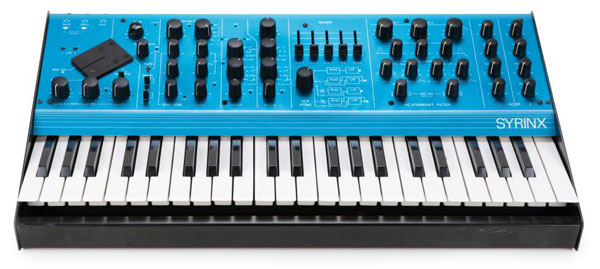
The Syrinx is one of the few analog synths to come out of the Netherlands. It's a monophonic lead synth in the same category as the Minimoog, Arp Odyssey, and Roland SH-7. But the Syrinx is pretty rare, only a few hundred were produced from 1983 through 1984.

The Syrinx uses seven Curtis chips for its VCO's, VCF's and envelopes. It has two analog VCO's, a sub-oscillator and three flexible voltage-controlled filters. You can switch between the three filters for either a 24 dB lowpass, or two bandpass filters, and they can be patched in four different ways (series/parallel). Additionally the Syrinx has two LFO's, FM, PWM, osc-sync, 2 ADSR envelopes, ring modulation, portamento and a cool touch-pad that can control various parameters from pitch-bending to the LFO rate. The Syrinx's Mixer section lets you adjust levels for each VCO and the sub-osc as well as the Noise Generator and Ring Modulator. Unfortunately, being released around 1983, the Syrinx just missed out on MIDI and patch memory options.
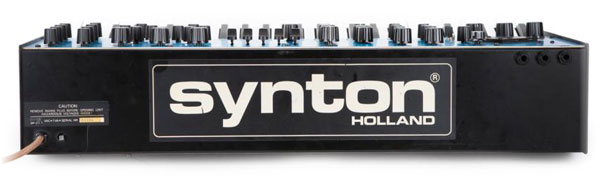
They came in a variety of flavors over the years. Most were black, but a handful were blue, red, or white. Some later models had no keyboard and were mounted in a flight-case, and a mid-nineties re-issue was a very rare rack-mount version with MIDI and external audio in. The Syrinx has been used by Aphex Twin, Xpando, Air, Vince Clarke, Depeche Mode, and Electronic Dream Plant.
You Might Also Like
Demos & Media
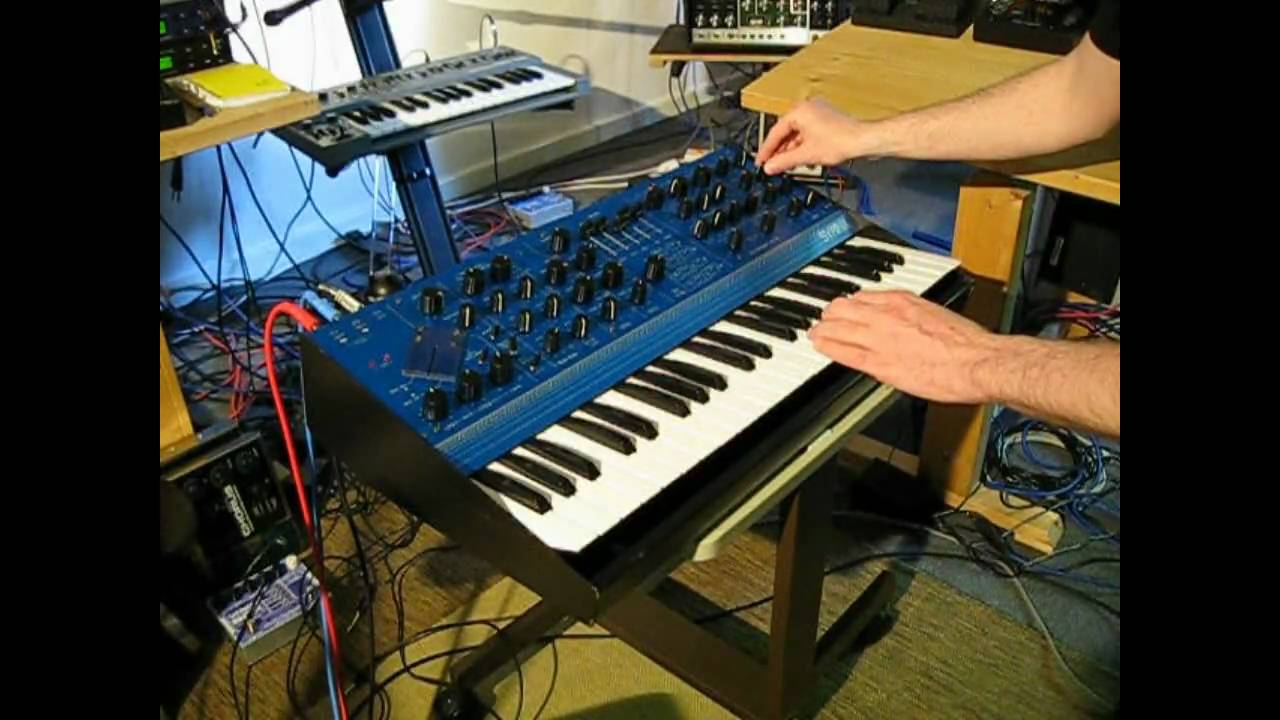
Synton Syrinx
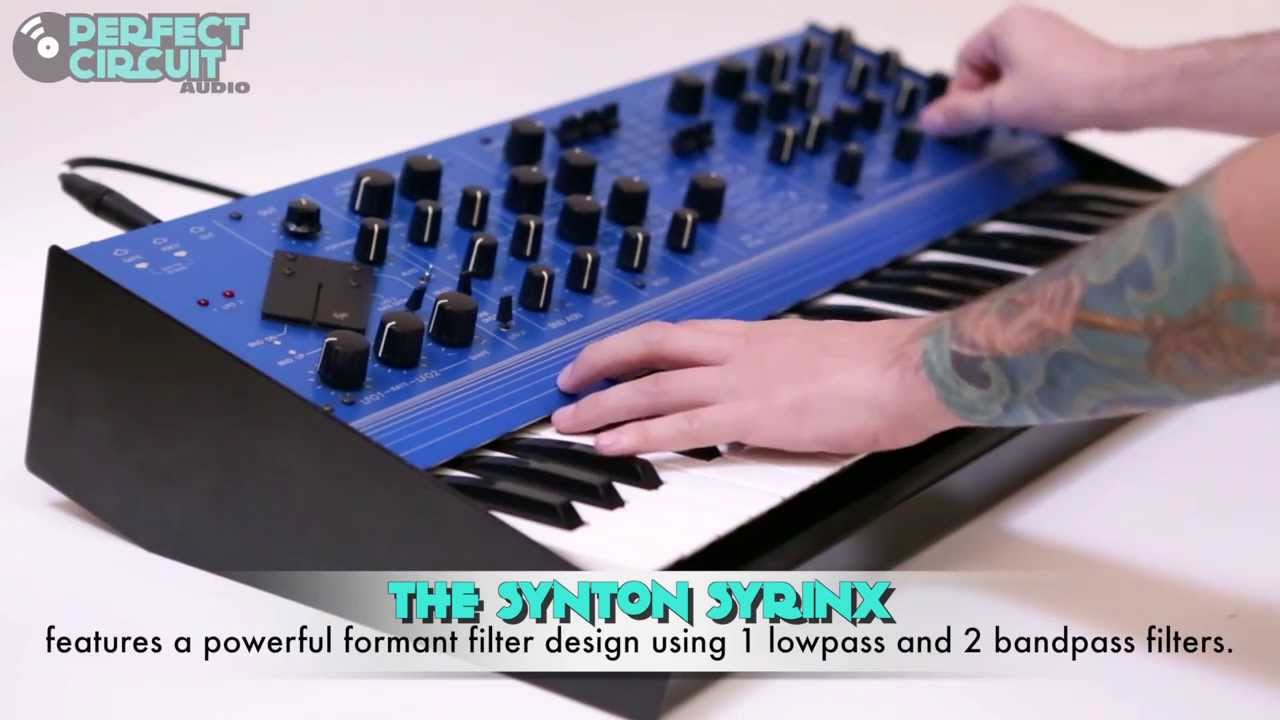
Synton Syrinx Demo
Audio Clip 1
A series of samples of various patches.
Specifications
Polyphony -
Monophonic
Oscillators -
2 VCO's (tri, saw, square, PWM) plus 1 sub-oscillator, ring modulation and noise gen.
LFO -
2
Filter -
2 Bandpass filters (Peak 1 & 2) and 1 Lowpass 24dB/oct filter. Individual cutoff and resonance controls, ADSR Envelope, Keyboard Tracking and LFO modulation
VCA -
2 ADSR filters (one can modulate the VCF)
Keyboard -
44-keys (3 1/2-octave, no velocity, low-note priority)
Arpeggiator -
None
Sequencer -
None
Memory -
None
Control -
CV / Gate (Moog type). Touch 'N Bend Pad.
Date Produced -
1983/84
Websites of Interest
Resources
Images from Perfect Circuit Audio.