Sequential Circuits Max
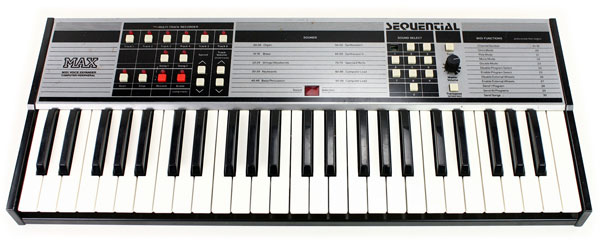
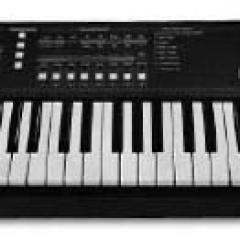
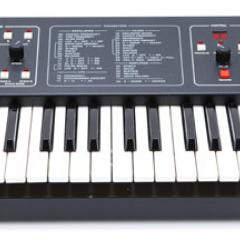
The Max's strength lies in multitimbrality: 6 voices, 6 oscillators and even 6 VCF's! However this synth has too many limitations on basic needs: cheap construction and parts; editing requires an external software editor and a Commodore 64 (or Macintosh, see Patch Files below); there are no real-time performance controls - not even pitch bend or modulation wheels; too many presets (80) but far too few user patches (20). The preset sounds consist of basic organ, string and brass type sounds, but exploring this analog synth can lead to some cool sounds. The VCF, VCA and VCO sections all have separate ADSR envelope generators. The LFO can control the VCO, VCF or VCA. A nice touch are the two separate on-board sequencers - sort of a Sequential tradition.
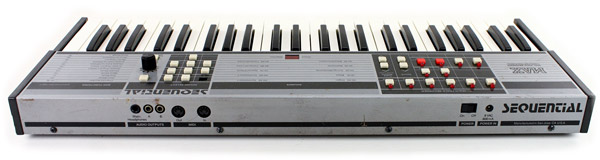
For those of you who want to edit the sounds on the Max, you will need Sequential's Model 920 software and an ancient Commodore 64 computer or you can use Mark of the Unicorn's Unisyn software editor for Mac/PC (You can even use modern MIDI controllers like the Oxygen-8). This is the only means of editing sounds, without which you are stuck with the 80 presets and whatever may be in the 20 user patches. The sequencing specs are dramatically enhanced by the Model 920 software as well, boosting the note capacity from 500 notes to 3400. Strongly consider the Multi-Track or even the Six-Track before diving into the Max because it simply does not compare with the programmability and ease of use as even its closest relatives. It is used by Cirrus and Richard Barbieri.
You Might Also Like

Demos & Media
100 SysEx PatchesThese are Midi SysEx patches by Jeff Bergman. They are for Macintosh and Windows/PC.
Factory PatchesThese are Midi SysEx patches from Moimir Papalescu.
Cubase Mixer-MapMixer maps for the SixTrak & Max by Grant Ransom & John Goodman for Windows/PC. Courtesy of NoteIt.
MOTU ConsoleMixer maps for the SixTrak & Max by Grant Ransom & John Goodman for Mac. Courtesy of NoteIt.
Specifications
Polyphony -
6 voices
Oscillators -
6 VCO's (saw, triangle, pulse waveforms)
Memory -
20 User patches, 80 presets
Filter -
6 24dB/oct lowpass VCF's (one per voice)
LFO -
1 LFO with Triangle & square waveforms. Controls VCO pitch, VCF, or VCA envelope
Keyboard -
49 Keys
Arpeg/Seq -
Two 6-track real-time sequencers (records up to 500 notes total and 2 songs)
Control -
MIDI
Date Produced -
1984
Websites of Interest
Resources
Images from Perfect Circuit Audio.